Maharashtra is taking a more structured approach to electric mobility with its Maharashtra Electric Vehicle Policy 2025. While EV incentives often receive most of the attention, the policy also places significant emphasis on the charging infrastructure required to support EV adoption.
For housing societies, real-estate developers and highway operators, this creates an important shift. EV charging is increasingly becoming something that needs to be considered as part of property planning, parking infrastructure and transportation infrastructure.
What Is the Maharashtra EV Policy 2025?
The Maharashtra EV Policy 2025 is designed to increase EV adoption while expanding the charging infrastructure needed to support electric mobility across the state. The policy covers EV adoption and incentives, charging infrastructure, residential and commercial buildings, highways and expressways, public transport, fleet operators, energy infrastructure and the wider EV ecosystem.
What the Policy Means for Housing Societies
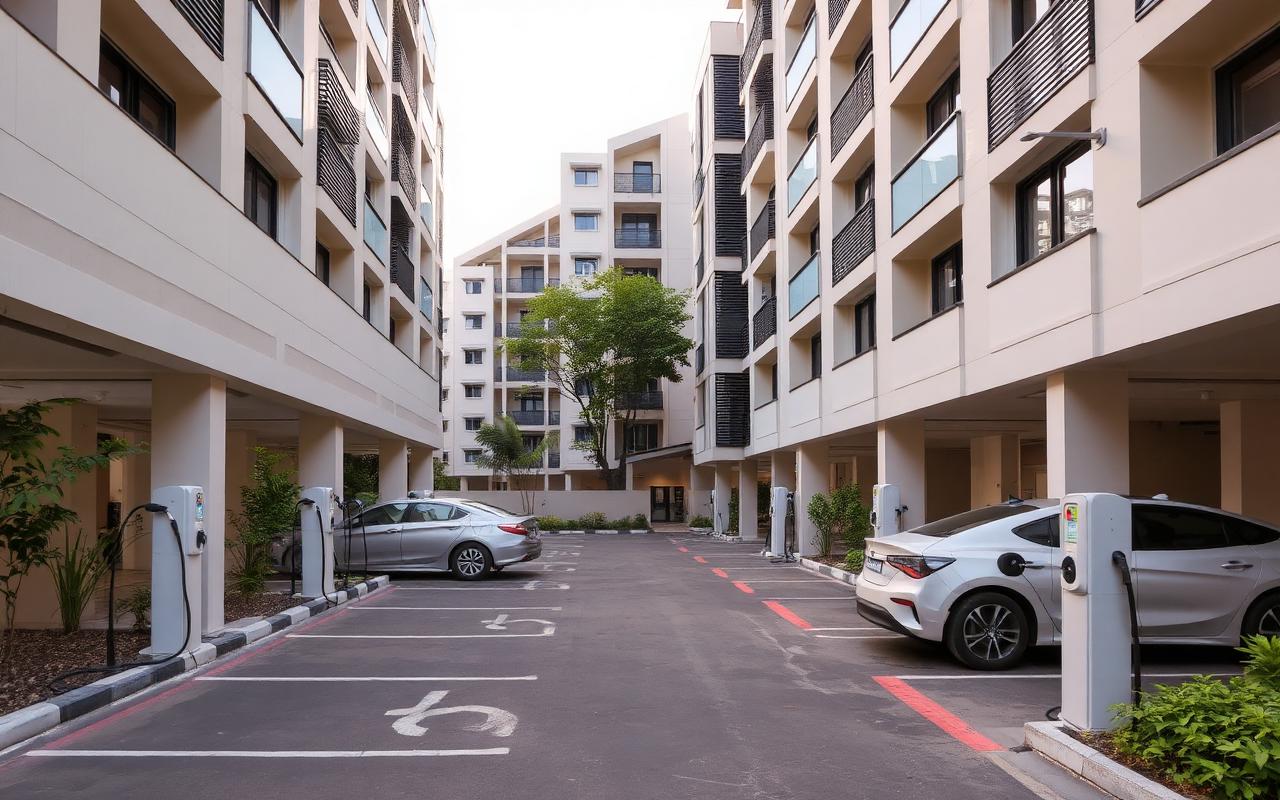
Housing societies are an important part of Maharashtra’s EV charging ecosystem because residential parking is where many EVs spend the longest amount of time. A vehicle parked overnight may not require an ultra-fast charging station. Instead, the parking space can potentially support scheduled or slower charging over several hours.
New residential buildings need to be designed for EV charging
The policy states that all parking spaces in new residential buildings are to be designed and constructed with EV charging facilities in mind. It also requires a dedicated charging point for community EV charging in each new residential building.
What About Existing Housing Societies?
Existing housing societies have a different situation. The policy provides for community EV charging space subject to approval from at least 50% of society members and compliance with applicable safety and operational standards.
Societies looking to introduce shared EV charging should consider where charging bays will be located, how electricity consumption will be measured, who will pay for charging, how charging slots will be allocated, how visitors can use chargers, how cables will be managed, how electrical capacity will be assessed and how future demand will be accommodated.
What Developers Need to Know
For developers, the biggest takeaway is that EV readiness needs to be considered during the planning stage. Retrofitting charging infrastructure after a building is completed can be more complicated than planning for it during construction.
The policy states that new commercial buildings should have at least 50% of their parking spaces suitable for EV charging, including provisions for future charger installation.
A Developer’s EV-Ready Checklist
- Parking layout
- Electrical load capacity
- Distribution infrastructure
- Cable routing and conduit
- Charger locations
- Dedicated charging bays
- Future expansion capacity
- Signage and wayfinding
- Pedestrian safety
- Fire-safety requirements
- Charging management systems
Commercial Buildings Have Another Requirement
For existing commercial buildings with shared parking, the policy provides that 20% of total parking spaces should have operational charging stations.
This is particularly relevant to office buildings, shopping centres, hotels, hospitals, commercial complexes, business parks and large parking facilities. For these properties, charging can go beyond infrastructure planning and become part of the overall customer and employee experience.
EV Charging Is Becoming Part of Property Infrastructure
One of the biggest changes is the way charging infrastructure should be viewed. Instead of waiting until EV demand becomes high, property owners can make suitable parking spaces EV-ready so charging can scale as demand increases.
An EV-ready parking space does not necessarily mean every parking bay needs a high-powered charger immediately. The property can instead be designed so additional chargers can be installed without completely redesigning the electrical and parking infrastructure.
What the Policy Means for Highway Operators
Long-distance EV adoption depends heavily on driver confidence. An EV driver travelling between cities needs to know that charging will be available along the route.
Maharashtra’s policy therefore targets charging facilities at 25-kilometre intervals along state and national highways. This creates opportunities for highway operators, fuel stations, parking operators, food plazas, restaurants, hotels, highway service areas, fleet operators and charging network operators.
Fuel Stations Are Becoming Potential EV Charging Locations
Subject to technical feasibility, the policy provides that existing and new fuel stations on state and national highways should have at least one EV charging facility. This is important because fuel stations already have many characteristics required for charging infrastructure, including road visibility, vehicle access, parking space, electrical infrastructure and customer facilities.
MSRTC Bus Stations Are Also Part of the Charging Network
The policy also states that, subject to technical feasibility, MSRTC bus stations and bus stops across the state should have at least one fast charging station.
Bus charging requires a different infrastructure strategy from passenger-car charging because operators need to consider fleet schedules, vehicle battery capacity, route length, charging windows, depot operations, electrical capacity and charger utilisation.
Highway Charging Is Not Just About Installing Chargers
Installing a charger along a highway is only one part of the equation. A successful highway charging station also needs easy access, clear signage, adequate electrical capacity, sufficient charging points, driver amenities and reliable operations.
Maharashtra Is Also Supporting High-Power Highway Charging
The policy establishes a structured framework for viability-gap funding for certain DC fast-charging infrastructure. Incentives are subject to eligibility, capacity limits and the applicable policy conditions, so operators should verify the current requirements before making an investment decision.
Mumbai–Pune and Other Major Corridors
The policy identifies major corridors including the Mumbai–Pune Expressway and Maharashtra Samruddhi Mahamarg in the broader sustainable-mobility and EV infrastructure context. For operators along major routes, charging infrastructure is expected to become increasingly important to long-distance EV mobility.
What This Means for Businesses
The Maharashtra EV Policy 2025 creates opportunities beyond traditional charging companies. Businesses that already own suitable property may be able to integrate EV charging into their existing operations.
Potential locations include shopping malls, hotels, restaurants, highway food plazas, office campuses, housing societies, hospitals, parking facilities, fleet depots, educational campuses and commercial complexes.
Why Smart Operators Should Plan Early
EV adoption does not happen overnight, but infrastructure decisions take time. A charging project may involve site assessment, parking evaluation, electrical load assessment, charger selection, connectivity planning, safety planning, approvals, installation, software integration, testing and ongoing maintenance.
Waiting until charging demand becomes extremely high can make expansion more difficult. Planning early allows property owners and infrastructure operators to understand where chargers should be installed and how the network can grow over time.
EV Charging Should Be Planned Around Usage
Not every location needs the same charger. A housing society may benefit from AC charging because vehicles remain parked for long periods. An office may use AC charging during working hours. A shopping destination may use a combination of AC and DC charging. A highway location may require high-powered DC fast charging because drivers want shorter stops. A fleet depot may require multiple high-power chargers combined with charging schedules and load management.
The right question is not which is the most powerful charger. It is what charging solution matches the vehicles, parking duration, electrical capacity and operating model of the location.
Software Will Become Increasingly Important
As charging networks expand, operators need more than physical charging equipment. Charging management software can help operators monitor charger availability, charging sessions, energy consumption, station status, faults, usage patterns, revenue and maintenance requirements.
Safety Cannot Be an Afterthought
EV charging infrastructure needs to be integrated with the property’s broader safety requirements. Operators should consider electrical protection, charger placement, cable management, vehicle movement, pedestrian movement, emergency access, fire-safety requirements, basement and covered parking conditions, drainage and equipment requirements.
A Practical Checklist for Housing Societies
- How many EVs are currently owned by residents?
- How many parking spaces could support charging?
- Is there sufficient electrical capacity?
- Should charging be individual or community-based?
- How will residents pay for electricity?
- How will charging sessions be allocated?
- Who will maintain the chargers?
- What happens when demand increases?
- Does the society have the required member approval?
- Are applicable safety standards being followed?
A Practical Checklist for Developers
- EV-ready parking design
- Electrical capacity
- Cable routing and conduit
- Distribution infrastructure
- Charger locations
- Dedicated charging spaces
- Future expansion
- Signage
- Safety requirements
- Charging management
- Customer access
A Practical Checklist for Highway Operators
- Distance from nearby charging stations
- Traffic volume
- EV traffic potential
- Available land
- Electrical connection
- DC charger capacity
- Number of charging points
- Parking layout
- Entry and exit routes
- Highway visibility
- Signage
- Driver amenities
- Maintenance access
- Remote monitoring
- Future expansion
The Bigger Opportunity for Maharashtra
The Maharashtra EV Policy 2025 is not only about encouraging people to buy EVs. It is also about building an ecosystem that makes EV ownership practical.
That ecosystem needs EVs, charging stations, parking, electricity infrastructure, highways, software, maintenance and safety. Housing societies provide the residential charging network. Developers create EV-ready buildings. Commercial properties provide destination charging. Highway operators support long-distance travel. Fuel stations can become charging hubs. Fleet operators create high-utilisation charging demand.
What Should Property Owners Do Now?
Property owners do not necessarily need to install a large charging network immediately. A better first step is to conduct a site and charging assessment covering current EV demand, parking utilisation, electrical capacity, user behaviour, charger requirements, future expansion, installation costs, safety requirements and software requirements.
From there, operators can develop a phased charging strategy: make selected parking spaces EV-ready, install initial AC or DC chargers, monitor utilisation and expand infrastructure based on actual usage.
Final Takeaway
The Maharashtra EV Policy 2025 signals a major change in how EV charging infrastructure should be viewed.
For housing societies, it means planning for residential charging and creating practical systems for shared charging. For developers, it means EV-ready parking needs to become part of building and infrastructure planning. For commercial property owners, charging can become both an infrastructure requirement and a customer amenity. For highway operators, the policy creates a clear direction toward more frequent and higher-powered charging infrastructure along major routes.
The biggest opportunity is not simply to install more chargers. It is to build the right charging infrastructure in the right locations, based on how people live, work, park and travel.
As Maharashtra moves toward its 2030 EV policy horizon, organisations that plan their charging infrastructure early can be better positioned to serve growing EV demand.
For housing societies, developers, commercial properties and highway operators, the time to assess EV charging infrastructure is not when the parking is already full of EVs. It is while there is still time to plan the infrastructure properly.
Frequently Asked Questions
What is the Maharashtra EV Policy 2025?
The Maharashtra EV Policy 2025 is the state’s electric-vehicle policy for the period from April 1, 2025, to March 31, 2030. It covers EV adoption, incentives, charging infrastructure, highways, buildings, public transport and related EV ecosystem development.
How many parking spaces in new residential buildings need to be EV-ready?
The policy states that all parking spaces in new residential buildings should be designed and constructed to support EV charging facilities.
What is the EV charging requirement for new commercial buildings?
The policy states that at least 50% of parking spaces in new commercial buildings should be suitable for EV charging, including provisions for future charger installation.
What does the policy say about existing commercial buildings?
For existing commercial buildings with shared parking, the policy states that 20% of parking spaces should have operational charging stations.
Can housing societies install shared EV chargers?
Yes. The policy provides for community EV charging space in housing societies, subject to approval from at least 50% of society members and compliance with applicable safety and operational standards.
How frequently should EV charging facilities be available on highways?
The policy targets EV charging facilities at 25-kilometre intervals along state and national highways.
Will highway fuel stations have EV chargers?
Subject to technical feasibility, the policy provides that existing and new fuel stations on state and national highways should have at least one EV charging facility.
Is there financial support for highway charging infrastructure?
The policy establishes a structured viability-gap funding framework for certain DC fast-charging infrastructure, with incentives subject to eligibility and applicable policy conditions.
What should developers do before installing EV chargers?
Developers should assess parking layouts, electrical capacity, cable routing, charger locations, safety requirements, future expansion and charging management before finalising the infrastructure design.
Why is EV-ready infrastructure important?
Planning EV-ready infrastructure during construction can make future charger installation easier and reduce the need for disruptive electrical and parking modifications later.
Looking to plan EV charging infrastructure? Weej Wala can help businesses, developers, housing societies and infrastructure operators evaluate EV charging requirements based on parking, electrical capacity, charging demand and future scalability.