

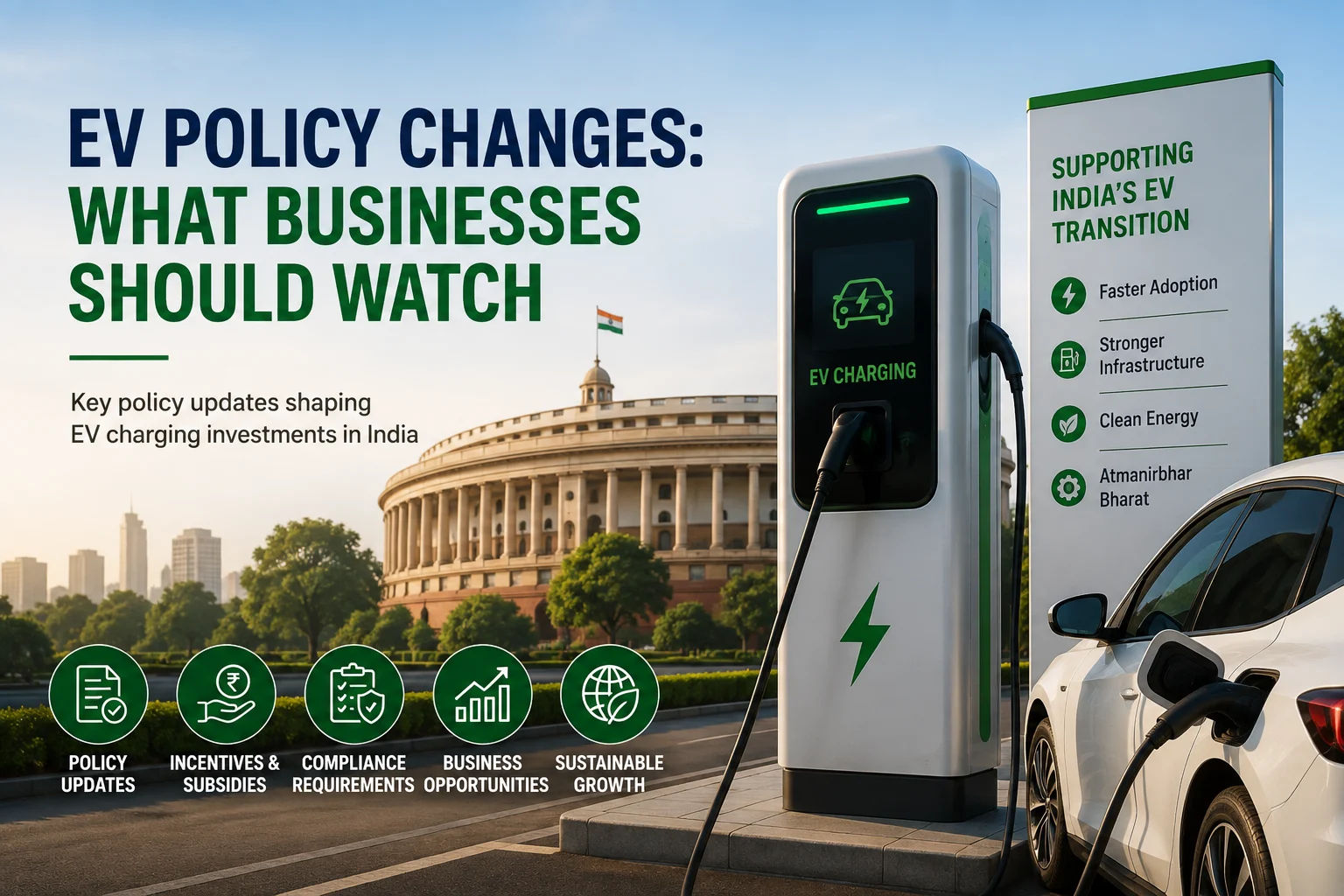
Policy Should Be Reviewed Before Finalising an EV Charging Investment
Businesses planning EV charging infrastructure should treat policy review as part of project planning rather than something checked after equipment is selected. Policies, operational guidelines, building requirements and incentive mechanisms can influence infrastructure decisions, documentation and implementation processes.
For Maharashtra businesses, the current policy environment should be reviewed together with the latest official operational guidelines and applicable electrical requirements before committing to a project.
Why Policy Matters to Businesses
Policy can affect how organisations approach new commercial buildings, residential developments, government-linked projects, highway infrastructure and charging deployment across different property types.
The practical objective for businesses is simple: understand the current requirements before finalising budgets and designs.
1. Review the Latest Maharashtra EV Policy
Maharashtra introduced its EV Policy 2025 as the current state policy framework. Businesses should always review the official government notification and subsequent operational circulars because implementation details can evolve through guidelines and administrative updates.
2. Understand Building and Parking Implications
Developers and commercial property owners should examine how EV charging provisions interact with building planning and parking design. Instead of treating charging as an afterthought, reserve suitable parking bays, electrical pathways and equipment locations during the planning stage whenever possible.
3. Check Incentive Eligibility Before Installation
Where incentive programmes are available, applicants should review eligibility, documentation, timelines and the official application process before beginning the project. Businesses should avoid assuming that every charging installation automatically qualifies for financial support.
4. Coordinate Electrical Planning Early
Charging infrastructure depends on the site’s electrical capability. Businesses should evaluate load availability, distribution systems, cable routes and connection requirements in coordination with the relevant distribution company and technical professionals.
5. Different Projects Have Different Requirements
| Business Type | Planning Focus |
|---|---|
| Office | Employee charging and parking dwell time |
| Commercial complex | Visitor access and scalable infrastructure |
| Housing development | Resident charging readiness |
| Highway property | Public access and operational reliability |
| Fleet facility | Operational charging schedules |
6. Keep Documentation Organised
Charging projects often involve technical drawings, electrical information, property documentation and administrative approvals. Maintaining organised documentation from the beginning can reduce delays during implementation.
7. Watch for Operational Circulars
Businesses should monitor official operational circulars issued alongside the policy because they can clarify application processes, implementation procedures and administrative requirements. The policy document is the foundation, while operational guidance explains how programmes are implemented in practice.
8. Plan for Expansion Rather Than One-Time Installation
Commercial EV charging demand can grow over time. Designing electrical pathways and parking infrastructure for phased expansion can reduce the cost and complexity of future upgrades.
9. Avoid Common Planning Mistakes
- Selecting chargers before reviewing infrastructure
- Ignoring parking layout
- Assuming incentives without checking eligibility
- Using outdated policy documents
- Failing to review operational guidelines
- Not planning future expansion
Business Checklist Before Installing Chargers
- Review the latest official policy and circulars
- Assess site demand and user type
- Evaluate parking and accessibility
- Review electrical capacity
- Confirm documentation requirements
- Check applicable incentive programmes
- Plan monitoring and maintenance
- Design for future scalability
Final Takeaway
Policy awareness does not replace engineering or commercial planning, but it helps businesses make better infrastructure decisions before capital is committed. Always use the latest official policy documents and implementation guidance during project planning rather than relying on outdated summaries.
Frequently Asked Questions
Should businesses rely on old EV policy summaries?
No. Always review the latest official policy notification and relevant operational guidelines before making investment decisions.
Can policy affect commercial building planning?
Yes. EV charging considerations can influence parking allocation, infrastructure readiness and project planning depending on the applicable framework.
Why should electrical planning happen before charger selection?
Because the available electrical infrastructure determines what charging equipment can realistically be installed and how scalable the project will be.