

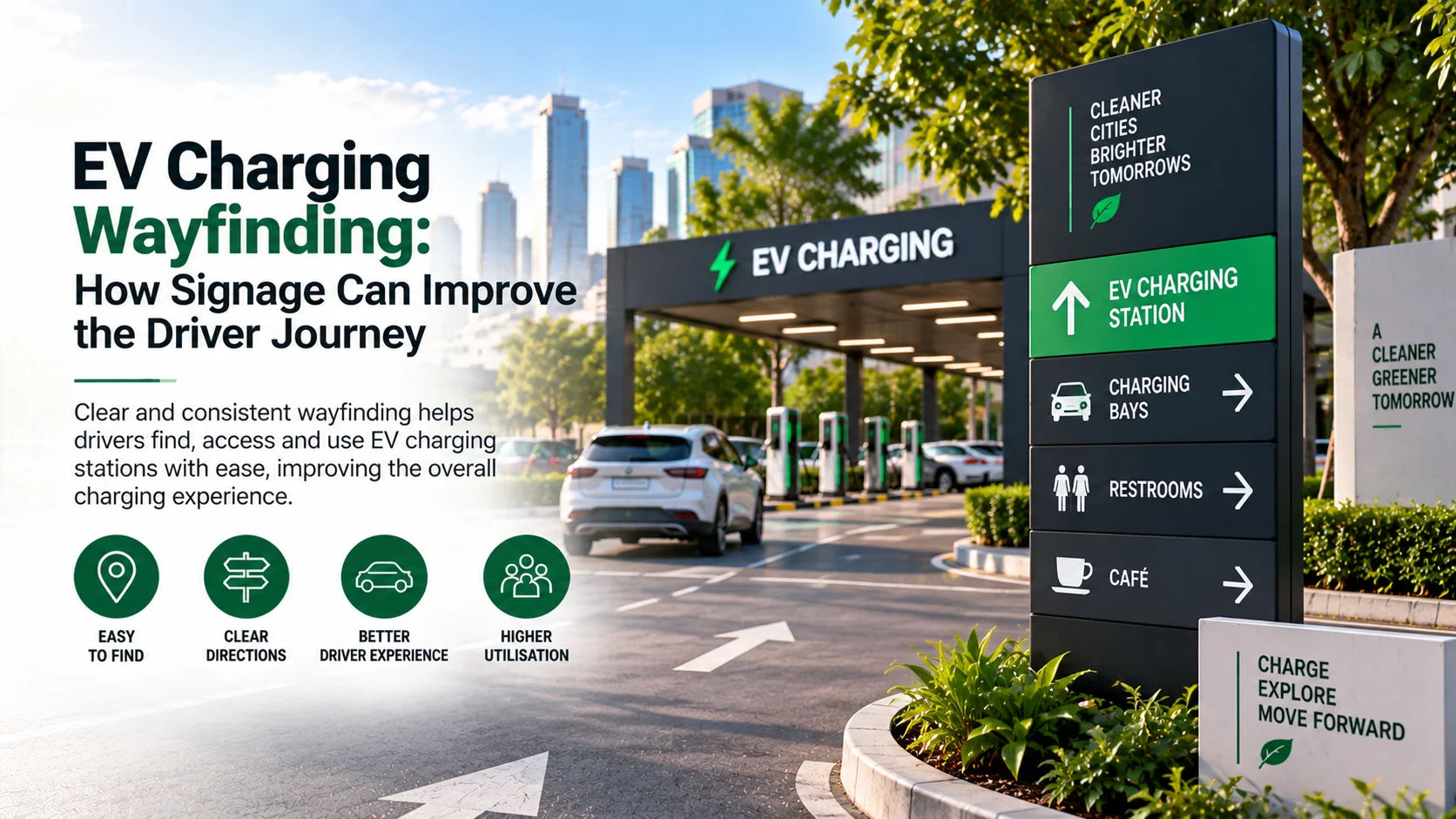
Finding an EV charger should feel simple. A driver should be able to understand where the charging station is, how to enter the site, which bay to use, and what to do next without unnecessary confusion. In practice, even a well-installed charging station can create a poor experience if drivers cannot easily find it.
This is where EV charging wayfinding becomes important. Wayfinding combines directional signs, parking signs, charger identification, road markings, entrance information and on-site instructions to guide a driver from the approach road to the charging point and then back onto their journey.
What Is EV Charging Wayfinding?
EV charging wayfinding is the visual guidance system used to help EV drivers navigate to and through a charging location. It can include signs outside the property, directional arrows, entrance boards, parking-bay markings, charger identification signs, safety instructions and exit guidance.
A useful wayfinding system answers the driver’s questions at the right moment:
- Where is the charging station?
- Which entrance should I use?
- Where are the EV charging bays?
- Which charger should I use?
- Where should I park while charging?
- What are the basic charging instructions?
- How do I leave the site after charging?
The goal is to provide this information progressively rather than placing every instruction on one crowded sign.
Why Signage Matters at EV Charging Stations
EV drivers make navigation decisions while approaching a property, parking area, fuel station, commercial building or highway stop. If charging bays are difficult to locate, a driver may pass the entrance, enter the wrong parking area or spend unnecessary time searching for the charger.
Good signage creates a predictable journey. It gives drivers confidence that they are heading in the right direction and helps them identify the charging area quickly. For operators, it can also reduce avoidable questions such as where the charger is or which bay should be used.
The EV Driver Journey: Where Wayfinding Should Start
1. Approach the Location
If the charging station is inside a large property, drivers need to know where to turn. An external sign or appropriate directional signage can identify the entrance or route to the charging area.
2. Enter the Property
Once inside, drivers should not have to guess which lane or driveway leads to the chargers. Directional arrows and simple EV charging identifiers can guide them through the site.
3. Find the Charging Bays
The charging area should be visually distinct. Clear signs and pavement markings can make EV bays easier to recognize, particularly in busy parking environments.
4. Identify the Correct Charger
If a site has multiple chargers, each unit or bay should be easy to identify. Consistent numbering helps drivers and support teams identify a particular charging point quickly.
5. Start the Charging Session
At the charger, concise instructions can explain the basic process, such as connecting the vehicle, using the relevant app or payment method, and starting the session.
6. Complete the Journey
Exit signs and normal site traffic guidance should make it clear how drivers leave the charging area. A complete wayfinding system considers both arrival and departure.
Key Types of EV Charging Signage
Directional Signs
Directional signs guide drivers toward the charging facility. They are useful when chargers are not visible from the property entrance or main access road. Keep messages short and use recognizable symbols, destination names and clear arrows.
Entrance Signs
An entrance sign can confirm that drivers have reached the correct access point. This is especially useful for large commercial properties and locations with multiple entrances.
Parking and Bay Signs
Parking-bay signs should make it clear which spaces are intended for charging. Pavement markings can reinforce the message and improve visibility.
Charger Identification Signs
Multiple charging units can be numbered or otherwise clearly identified. Consistent labels give drivers and support teams a simple way to identify a specific charger.
Instructional Signs
Instructional signage should focus on the actions a driver actually needs to take. If the charging process is already explained in an app, physical signage can provide a concise reminder instead of duplicating every step.
Safety and Operational Signs
Where appropriate, signs can communicate operational or safety information, including keeping access routes clear, following site rules or contacting support when a charger has a problem. Safety messaging should remain clear without overwhelming the primary navigation information.
Design Principles for Better EV Charging Wayfinding
Keep the Message Simple
Drivers should understand a sign quickly. Use short phrases, recognizable symbols, clear arrows and enough visual separation between different pieces of information.
Use Consistent Signage
The same visual language should continue from the entrance to the charging bay. Consistent terminology helps drivers understand that each sign is part of the same route.
Place Signs Before the Decision Point
A directional sign placed after a turn is not very useful. Drivers need information before they have to choose a lane, turn, ramp or parking area. Think about the exact point at which a decision is required.
Make Signs Easy to See
Signage should remain visible in realistic conditions, including busy parking areas, different lighting conditions, parked vehicles and changing traffic patterns. Physical placement is as important as graphic design.
Use Arrows Carefully
An arrow should clearly correspond to the direction the driver needs to take. Avoid layouts where multiple arrows compete for attention or the intended direction is ambiguous.
Design for First-Time Visitors
A regular customer may already know where the charger is. A new driver does not. Good wayfinding should work for someone visiting the location for the first time without relying on local knowledge.
Wayfinding for Different EV Charging Locations
Housing Societies
Residential charging areas can become confusing when parking is shared or spread across multiple buildings. Clear identification of EV charging spaces can help residents and visitors understand where charging is permitted. Multi-level parking facilities can also benefit from floor-level and directional signs.
Corporate Offices
Office campuses often have employee parking, visitor parking, security gates and multiple internal roads. EV charging signs should guide drivers from the appropriate entrance to the charging bays without creating unnecessary detours.
Malls, Hotels and Hospitals
Destination charging locations have an additional challenge: drivers may be unfamiliar with the property’s parking layout. Wayfinding should connect the main entrance, parking levels, EV charging area and pedestrian access points.
Highway Stops
At highway locations, drivers generally want to identify the charging facility quickly. Signs should be visible early enough for drivers to safely prepare for the turn or entrance. Once inside, clear directional signage can reduce the time spent looking for charging bays.
Fleet Depots
Fleet sites may have multiple vehicle types, chargers, parking lanes and operating zones. Wayfinding can be integrated with bay numbering and operational instructions so drivers know exactly where each vehicle should go.
Common EV Charging Signage Mistakes
The Charger Is Hidden
A charging station can be technically accessible but practically difficult to find. If drivers cannot see it or do not know where to look, the infrastructure does not deliver a smooth experience.
Signs Appear Too Late
When a driver sees a directional sign only after passing the relevant turn, the sign has failed at the most important moment.
Too Much Information
Trying to put directions, payment information, pricing, safety rules, connector details and support contacts onto one sign can create visual clutter. Separate navigation information from detailed operational information where possible.
Inconsistent Naming
Using different names for the same charging area across signs, apps and property instructions can create uncertainty. Consistent terminology creates a connected driver experience.
Ignoring Parking Enforcement
Charging bays can become difficult to use if non-EVs occupy them or vehicles remain parked after charging. Operators should communicate applicable parking rules clearly and ensure enforcement procedures are practical for the site.
How Digital and Physical Wayfinding Can Work Together
Physical signage and digital navigation should complement each other. A driver may discover a station through an app or map service before arriving, but once inside the property, digital navigation may not accurately describe the internal parking layout.
Physical signs can take over at this point. The digital journey can say that the driver has arrived at the location, while on-site signs can answer the next question: where exactly do I go now?
For charging operators, keeping the station name and location information consistent across digital platforms and physical signage can also make customer support easier.
A Practical EV Charging Wayfinding Checklist
- Is the charging location identifiable before the driver reaches the entrance?
- Is the correct entrance clearly indicated?
- Are directional signs positioned before important decision points?
- Are charging bays easy to recognize?
- Are chargers or bays numbered where multiple units are installed?
- Are arrows clear and consistent?
- Can first-time visitors understand the route without staff assistance?
- Are signs visible when vehicles are parked nearby?
- Is the charging area clearly separated from general parking where appropriate?
- Are basic operational or safety instructions easy to understand?
- Is terminology consistent with the station’s digital listing?
- Is there clear guidance for leaving the charging area?
- Has the complete route been tested from a driver’s perspective?
How Operators Can Test Their Wayfinding
One of the simplest ways to evaluate signage is to conduct a real driver-journey test. Ask someone unfamiliar with the property to navigate from the main approach point to a charging bay without verbal assistance.
Observe where they slow down, hesitate, take a wrong turn or ask questions. These moments reveal where an additional sign, clearer arrow, better placement or simpler message may be needed.
Testing can be repeated at different times if the site changes significantly between daytime and nighttime conditions or between normal and peak parking periods.
Why Wayfinding Is Part of the Charging Experience
EV charging is not only about charger power, connector compatibility, software or payment. The driver experiences the entire process from discovering the station to entering the site, locating the charger, starting the session and leaving.
Wayfinding sits directly inside that journey. A charger that is fast and reliable can still feel inconvenient if the driver cannot find it easily.
For charging operators and site partners, investing in clear signage is a practical way to remove friction from the customer experience. The objective is simple: help drivers know where to go, what to do and how to continue their journey with as little confusion as possible.
Conclusion
EV charging wayfinding should be planned as part of the charging station itself, not added as an afterthought. From the first directional sign to the charging bay and exit route, every decision point should give drivers the information they need.
Whether the site is a housing society, corporate office, mall, hotel, hospital, highway stop, parking facility or fleet depot, clear signage can make the charging journey easier to understand and more predictable.
For operators planning new charging infrastructure, the best time to plan wayfinding is during site design and installation, not after drivers begin using the station.
Frequently Asked Questions
What is EV charging wayfinding?
EV charging wayfinding is the use of directional signs, arrows, parking markings, charger identification and instructions to guide drivers from the approach to the charging station and through the site.
Why is signage important for EV charging stations?
Clear signage helps drivers locate charging bays, understand where to enter, identify the correct charger and navigate the site without unnecessary confusion.
Where should EV charging signs be placed?
Signs should generally be placed before key decision points, including entrances, turns, ramps, parking-level changes and the approach to the charging area.
Should EV chargers have numbered bays?
Numbering can be useful at sites with multiple charging points because it gives drivers and support teams a simple way to identify a specific bay or charger.
Can digital navigation replace physical EV charging signage?
Digital navigation can help drivers reach the property, but physical signage remains useful for guiding them through internal roads, parking areas, ramps and charging bays.