

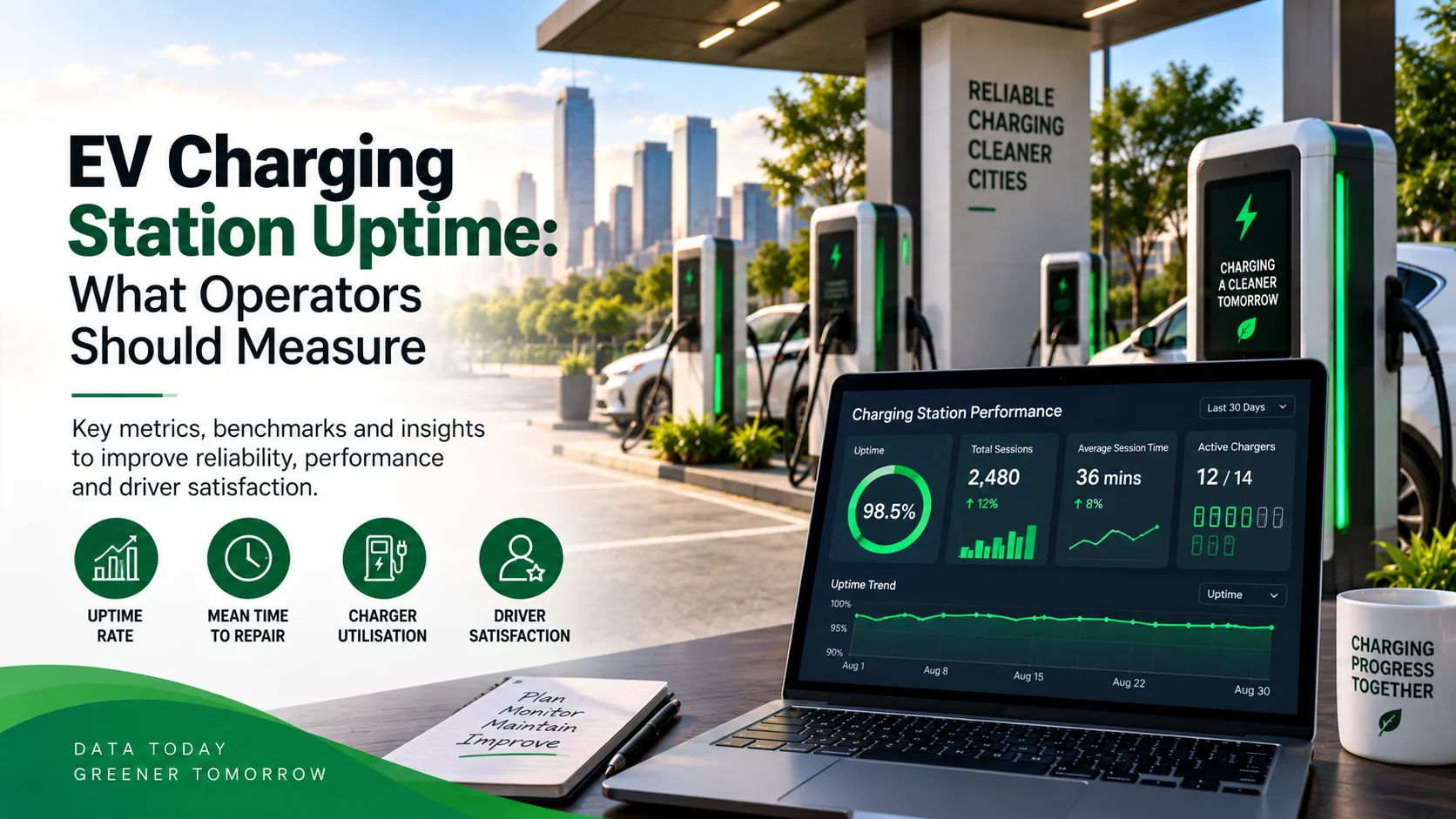
For an EV charging operator, installing a charger is only the beginning. Drivers need to find an available charger, start a session, receive the expected charging service, complete payment where applicable, and leave without unnecessary interruptions. If chargers are frequently offline or unavailable, even a well-located station can deliver a poor customer experience.
This is why EV charging station uptime is one of the most important operational metrics for charging operators. But uptime should not be treated as a single percentage displayed on a dashboard. Operators need to understand what is available, what is actually working, how long faults remain unresolved, and whether individual chargers are creating recurring problems.
This guide explains the key uptime and reliability metrics operators should monitor, how to interpret them, and how operational data can be used to improve charging-station performance.
What Is EV Charging Station Uptime?
EV charging station uptime generally refers to the amount of time a charging station is available and capable of providing its intended service compared with the total time it is expected to operate.
A simple uptime calculation can be expressed as:
Uptime % = available operating time ÷ scheduled operating time × 100
However, the exact definition of “available” matters. A charger can be powered on but still fail to start a charging session. It can also be online from a software perspective while experiencing a connector, payment, communication, or electrical problem.
For this reason, operators should define uptime in a way that reflects the actual driver experience.
Why Uptime Matters to Charging Operators
Charger availability directly affects the service a charging network provides. When a charger is unavailable, the operator can lose potential charging sessions while drivers may move to another station.
Reliable infrastructure can also reduce support workload. If chargers experience repeated faults, operators may receive more customer complaints, manual support requests, refunds, and maintenance tickets.
Monitoring uptime therefore helps operators answer several practical questions:
- How often are chargers unavailable?
- Which chargers have the most downtime?
- How long do faults remain unresolved?
- Are failures concentrated in particular locations or components?
- Is downtime caused by hardware, connectivity, software, power, or another issue?
- Are maintenance teams responding quickly enough?
Measure Uptime at More Than One Level
Looking only at network-wide uptime can hide problems. An operator may report a high overall percentage while a small number of individual chargers experience repeated outages.
Track performance at several levels:
- Network level: Overall charging infrastructure availability.
- Site level: Availability at each charging location.
- Charger level: Performance of each individual charger.
- Connector level: Availability of individual connectors where applicable.
This hierarchy makes it easier to identify where operational attention is required.
1. Overall Charger Uptime
Overall uptime provides a high-level view of network reliability. It is useful for management reporting and for identifying broad changes in performance over time.
However, it should be viewed alongside more detailed metrics. A network-wide number alone cannot explain why chargers were unavailable or whether certain locations are significantly underperforming.
2. Charger Availability
Availability measures whether a charger is currently usable or available for a new charging session. This is particularly useful for customer-facing operations because it reflects the number of charging points that drivers can actually access.
Operators can monitor availability in real time and compare it with historical patterns to identify recurring issues.
3. Successful Session Start Rate
A charger can appear online but still fail when a driver attempts to begin a session. Tracking the percentage of charging attempts that successfully start can reveal problems that a basic connectivity or uptime metric may miss.
For example, repeated session-start failures could be related to authentication, connector communication, payment processing, software configuration, or vehicle-charger communication.
4. Charging Session Completion Rate
Operators should also measure whether charging sessions complete normally. Unexpected interruptions can create a poor customer experience even when the charger was technically available at the beginning of the session.
Tracking completed sessions alongside interrupted sessions helps identify reliability problems that occur during charging rather than only before a session begins.
5. Mean Time to Detect
Mean Time to Detect (MTTD) measures how long it takes an operator or monitoring system to identify a fault after it occurs.
Fast detection can reduce the duration of downtime because maintenance or support teams can begin investigating sooner.
Remote monitoring and automated alerts can be particularly useful for detecting issues that may not be immediately visible to an on-site team.
6. Mean Time to Repair
Mean Time to Repair (MTTR) measures the average time required to restore a faulty charger to service.
A charger may experience only a small number of faults but still create significant operational impact if each repair takes a long time. Monitoring MTTR helps operators evaluate maintenance response and identify locations where spare parts, technician availability, or escalation procedures may need improvement.
7. Total Downtime
Total downtime shows the amount of time a charger or site was unavailable during a defined period.
It is useful to review downtime by:
- Day
- Week
- Month
- Location
- Charger
- Fault type
This makes recurring patterns easier to identify.
8. Planned vs Unplanned Downtime
Not all downtime has the same meaning. Planned maintenance may temporarily take a charger offline and can be managed differently from an unexpected hardware failure.
Separate:
- Planned downtime: Scheduled maintenance, upgrades, inspections, or other planned activities.
- Unplanned downtime: Unexpected faults, communication failures, power problems, or other service interruptions.
This distinction gives operators a more accurate view of unexpected reliability problems.
9. Fault Frequency
Count how frequently each charger experiences faults. A charger that repeatedly enters an error state may require more attention than one with a rare isolated issue.
Fault frequency can be analyzed by charger model, location, component, error code, environmental condition, or other relevant factors when the required data is available.
10. Recurring Faults
Repeated faults deserve special attention. Resetting a charger every time the same error occurs may restore service temporarily without solving the underlying problem.
Operators should identify repeated error codes and investigate whether they point to a common hardware, software, network, electrical, or operational cause.
11. Energy Delivered During Available Time
Uptime alone does not tell an operator how effectively a charger is being used. A charger can be available for most of the month but have very low utilization.
Track uptime alongside:
- Energy delivered
- Charging sessions
- Average session duration
- Average energy per session
- Peak charging periods
- Revenue where applicable
These metrics provide a clearer picture of both reliability and commercial performance.
12. Connector-Level Availability
At sites with multiple connectors, one connector can fail while another remains operational. Measuring only charger-level status can hide this difference.
Where the charging system supports connector-level monitoring, operators should track which connectors are available and which require service.
What Causes EV Charger Downtime?
Downtime can come from many sources. Operators should categorize incidents so that recurring causes can be identified.
Hardware Failures
Components such as charging cables, connectors, power electronics, cooling systems, contactors, displays, payment hardware, or other equipment can require maintenance.
Power Supply Problems
Electrical interruptions, protection trips, voltage-related issues, or other site-level electrical problems can affect charger availability.
Connectivity Problems
Connected chargers depend on communication between the charger and backend platform. Network or communication issues can affect monitoring, authentication, payment, or session management.
Software and Configuration Issues
Firmware, backend configuration, authentication, payment, or communication settings can contribute to failed sessions or unexpected charger behavior.
Environmental Conditions
Outdoor charging equipment may operate in heat, rain, dust, humidity, and other environmental conditions. Site-specific environmental exposure should be considered when planning maintenance and protection.
Human and Operational Issues
Incorrect parking, blocked chargers, damaged cables, misuse, or other operational conditions can also affect availability.
Use a Clear Fault Classification System
Every downtime event should ideally have a category. A simple classification system can include:
- Hardware
- Electrical
- Connectivity
- Software
- Payment
- Vehicle or connector communication
- Site access
- Maintenance
- External utility issue
- Unknown
The exact categories can be adapted to the operator’s infrastructure. The important point is to capture enough information to identify patterns instead of recording every incident as a generic “offline” event.
Set Up an Escalation Process
Monitoring is most useful when it leads to action. Operators should define what happens after a charger goes offline.
A practical workflow can include:
- Detect the issue through monitoring or customer reporting.
- Classify the fault.
- Attempt an approved remote diagnostic or recovery action where appropriate.
- Create a maintenance ticket if on-site intervention is required.
- Assign the incident to the appropriate team.
- Track the repair from assignment to restoration.
- Confirm that the charger is operational after repair.
- Record the root cause and corrective action.
This creates a complete record that can be used for future reliability improvements.
Monitor Uptime Trends, Not Just Monthly Averages
A monthly uptime percentage can look acceptable while concealing short but frequent failures. Operators should examine trends over time and look for clusters of incidents.
Useful comparisons include:
- Month-over-month uptime
- Site-to-site uptime
- Charger-to-charger uptime
- Fault frequency by month
- MTTR trends
- Session failure trends
Trend analysis can reveal whether reliability is improving after a maintenance program, software update, hardware replacement, or site intervention.
Uptime and Customer Experience
From the driver’s perspective, “the charger is online” is not enough. The driver needs to be able to locate an available bay, connect the vehicle, authenticate, start the session, receive energy, and complete the session successfully.
For this reason, operators should connect technical uptime metrics with customer-facing outcomes such as successful session starts, completed sessions, support requests, and reported charging failures.
A customer-oriented reliability dashboard can therefore provide a more meaningful picture than a single availability percentage.
Uptime and Revenue
For commercial charging operators, downtime can represent lost charging opportunities. The impact depends on the location’s demand, charger capacity, pricing model, and the duration of the outage.
Operators can estimate potential revenue exposure by combining downtime data with historical charging demand. This can help prioritize repairs based not only on how often a charger fails, but also on the operational impact of the failure.
However, revenue should not be the only criterion. Safety-related or repeated faults may require immediate attention regardless of short-term revenue impact.
Preventive Maintenance and Uptime
Preventive maintenance can help operators identify potential problems before they result in prolonged outages. Maintenance schedules should reflect the equipment, environment, usage level, manufacturer guidance, and site conditions.
Useful preventive-maintenance activities may include visual inspections, cable and connector checks, cleaning where appropriate, electrical checks, firmware management, communication checks, and review of historical fault patterns.
The specific maintenance procedure should follow the equipment manufacturer’s requirements and appropriate electrical and safety practices.
Remote Monitoring Can Improve Response Time
For distributed charging networks, remote monitoring can provide visibility without requiring an operator to physically inspect every charger.
A connected platform can help operators see charger status, session information, error conditions, historical activity, and other operational data. Alerts can then be used to bring attention to faults that require investigation.
Remote monitoring does not eliminate the need for field maintenance, but it can reduce the time between a fault occurring and the operator becoming aware of it.
What Should an EV Charging Uptime Dashboard Show?
A practical dashboard can include:
- Current online/offline chargers
- Uptime percentage
- Availability percentage
- Active faults
- Open maintenance tickets
- MTTD
- MTTR
- Total downtime
- Planned vs unplanned downtime
- Session start success rate
- Session completion rate
- Energy delivered
- Fault frequency
- Top recurring error types
Operators can then drill down from network-level performance to individual sites, chargers, connectors, and incidents.
A Practical EV Charging Uptime KPI Framework
| KPI | What It Shows | Why It Matters |
|---|---|---|
| Uptime | Time infrastructure is operational | Provides a high-level reliability measure |
| Availability | Charging points currently available | Reflects immediate service capacity |
| MTTD | Time to detect faults | Shows monitoring responsiveness |
| MTTR | Time to restore service | Shows maintenance response |
| Session start rate | Successful charging starts | Identifies issues beyond basic connectivity |
| Completion rate | Sessions completed successfully | Shows reliability during charging |
| Fault frequency | How often faults occur | Identifies problematic equipment |
| Total downtime | Time unavailable | Shows operational impact |
How Operators Can Improve EV Charging Uptime
1. Monitor Every Charger
Centralized visibility makes it easier to identify offline equipment quickly.
2. Track the Reason for Every Outage
Good incident data makes recurring causes easier to identify.
3. Reduce Detection Time
Use appropriate monitoring and alerting so that faults are identified quickly.
4. Improve Repair Workflows
Clear ownership, escalation and ticket tracking can help reduce unnecessary repair delays.
5. Maintain Critical Spares
Where justified by the equipment and operating model, keeping appropriate spare parts available can reduce waiting time for common repairs.
6. Analyze Repeat Failures
Do not treat recurring faults as independent incidents. Look for the underlying pattern.
7. Compare Sites
Location-level comparisons can reveal environmental, electrical, operational, or maintenance differences that affect reliability.
8. Combine Uptime With Customer Metrics
Measure whether technical improvements actually increase successful charging sessions and reduce customer-facing failures.
Common Uptime Measurement Mistakes
Using Only One Uptime Number
A single network-wide percentage can hide individual charger problems.
Counting Online Status as Full Usability
A charger may be connected to the backend but still fail to start or complete charging sessions.
Ignoring Planned Downtime
Planned maintenance should be separated from unexpected outages so reliability reporting remains meaningful.
Not Recording Root Causes
If every incident is marked simply as “offline,” operators lose information that could prevent future failures.
Measuring but Not Acting
A dashboard is useful only when its alerts and trends lead to operational decisions.
EV Charging Station Uptime Checklist
- Is uptime clearly defined for the charging network?
- Are uptime and availability tracked separately?
- Can operators see individual charger status?
- Can connector-level availability be monitored where applicable?
- Are session-start failures measured?
- Are interrupted sessions tracked?
- Are planned and unplanned outages separated?
- Is MTTD measured?
- Is MTTR measured?
- Are downtime events classified by cause?
- Are recurring faults identified?
- Are maintenance tickets linked to outage events?
- Is energy utilization reviewed alongside uptime?
- Are reliability trends reviewed regularly?
- Is there a defined escalation process for offline chargers?
Conclusion
EV charging station uptime is more than a percentage on an operations dashboard. For charging operators, reliable service depends on detecting faults quickly, restoring equipment efficiently, understanding recurring problems, and measuring whether chargers are actually usable from the driver’s perspective.
By tracking uptime, availability, session success, downtime, MTTD, MTTR, fault frequency, energy delivery and other operational indicators, operators can build a clearer picture of charging-network reliability.
For Weej Wala partners, combining charger monitoring with structured maintenance and performance analysis can support more dependable EV charging infrastructure across offices, housing societies, commercial properties, public charging locations, highway stops and fleet depots.
Frequently Asked Questions
What is EV charging station uptime?
EV charging station uptime is the proportion of scheduled operating time during which a charging station is available to provide its intended service. Operators should define exactly what counts as available.
What is the difference between uptime and availability?
Uptime generally measures operational time over a defined period, while availability is often used to describe whether a charging point is currently usable or ready for a new session. The exact definitions should be established by the operator.
What is MTTR in EV charging?
Mean Time to Repair (MTTR) is the average time required to restore a charger or other charging asset after a fault.
Why should operators track failed charging sessions?
Failed sessions can reveal problems that may not appear in a basic online/offline metric. A charger can be connected to a backend platform but still fail when a driver attempts to start or complete a session.
How can operators reduce charger downtime?
Operators can improve uptime by monitoring chargers, detecting faults quickly, maintaining appropriate equipment, improving repair workflows, analyzing recurring failures, and using operating data to guide preventive maintenance.
Should planned maintenance count as downtime?
Planned maintenance can be recorded as downtime, but it is useful to separate it from unplanned downtime so operators can distinguish scheduled service activity from unexpected reliability failures.