

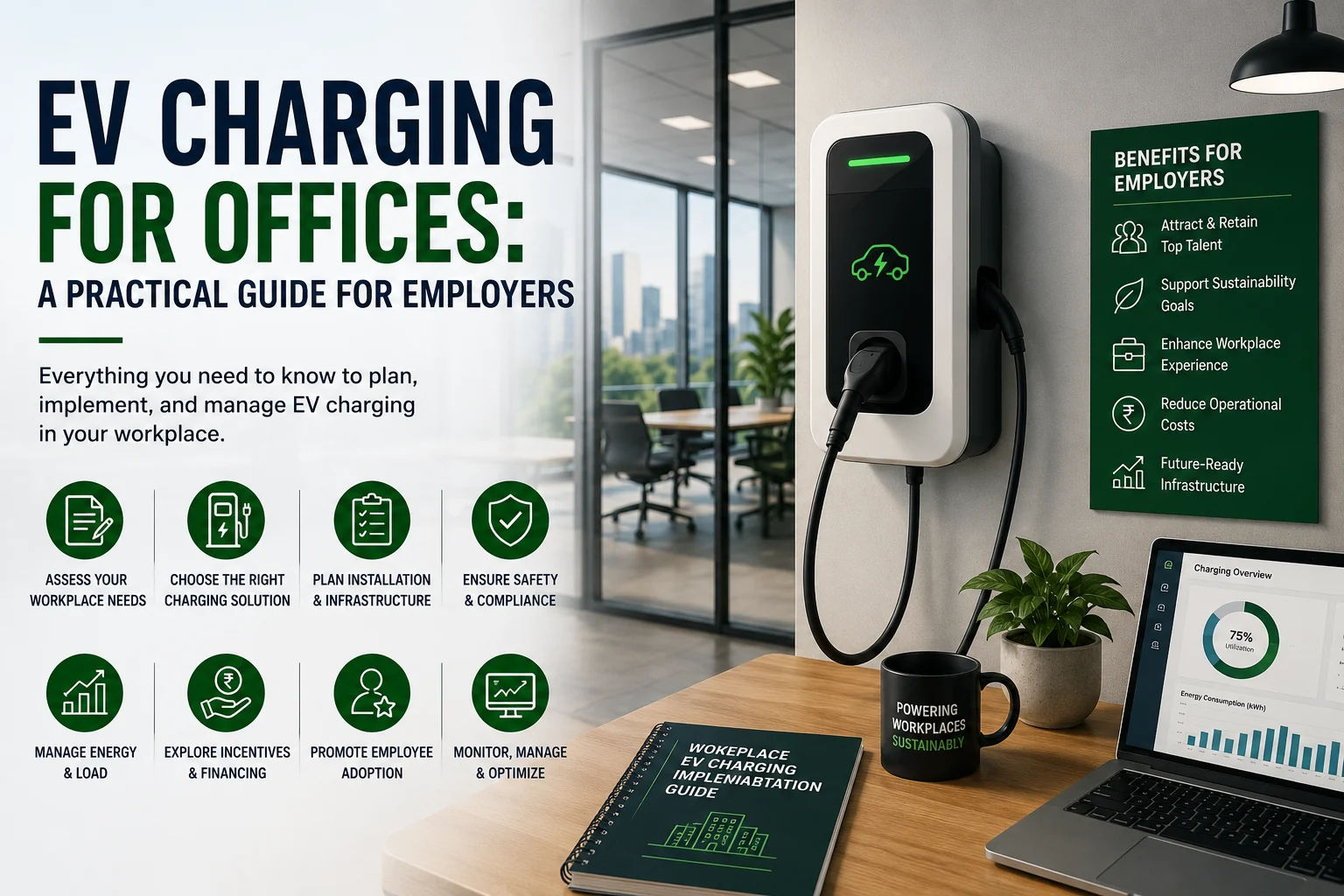
EV Charging at the Workplace Is Becoming a Practical Infrastructure Decision
For many employers, EV charging is no longer simply an employee perk. It is becoming part of workplace infrastructure planning alongside parking, electrical systems, visitor facilities and sustainability initiatives. Offices are particularly suitable for EV charging because employees often leave their vehicles parked for several hours, creating a natural opportunity for destination charging.
A successful workplace charging project begins with understanding how employees use the parking area, how much electrical capacity is available and how the organisation wants charging access to work. The objective is not to install the biggest charger possible. It is to create a reliable charging system that fits the workplace.
Why Offices Are Well Suited for EV Charging
Unlike highway charging, workplace charging usually serves predictable users. Employees arrive in the morning, park during office hours and leave later in the day. That longer dwell time often makes AC charging a practical option for many offices because vehicles can charge while employees work.
- Long parking duration
- Predictable user base
- Controlled parking access
- Potential visitor charging
- Opportunity for phased expansion
Start by Understanding Employee Demand
Before purchasing charging equipment, conduct a simple demand assessment. Ask how many employees currently own EVs, how many are considering purchasing one and whether company fleets may electrify in the future.
Useful information includes employee commuting distance, parking duration, number of reserved parking spaces and expected visitor usage. Demand should be reviewed periodically because EV adoption can grow over time.
Choose the Right Charging Approach
Most offices should begin by evaluating the charging behaviour rather than focusing only on charger power ratings. Employees parked for six to ten hours may benefit from AC charging, while organisations with operational vehicles that require rapid turnaround may evaluate faster charging for selected use cases.
| Office Scenario | Planning Direction |
|---|---|
| Corporate office with employee parking | AC charging is often suitable |
| IT park with long stay parking | AC with smart load management |
| Office plus visitor parking | Controlled access with separate visitor policy |
| Commercial campus with fleet vehicles | Evaluate mixed charging needs |
Evaluate Electrical Capacity Early
Electrical planning should happen before finalising the charger quantity. The existing electrical connection, building load, distribution boards, cable routes and future expansion requirements all influence what can realistically be installed.
Many projects become more expensive because infrastructure is reviewed after equipment selection. Early electrical assessment helps organisations plan budgets more accurately and avoid unnecessary redesign later.
Smart Load Management Can Improve Efficiency
Not every workplace needs to provide maximum charging power to every vehicle at the same time. Smart load management can distribute available electrical capacity across connected chargers based on predefined rules and demand. This helps organisations use available infrastructure more efficiently while supporting multiple users.
Create a Fair Employee Charging Policy
Technology alone does not solve workplace charging. Employers should also define who can use the chargers, whether charging is free or paid, how long vehicles may occupy charging bays and how visitors are handled.
- Employee eligibility
- Booking or first-come access
- Maximum parking duration
- Charging etiquette
- Visitor access
- Internal billing policy if applicable
Think About Parking Design
Charging bays should be convenient without disrupting overall parking circulation. Good placement improves accessibility for drivers and allows maintenance teams to service equipment safely.
Consider vehicle movement, cable reach, signage, bay markings and protection from accidental impact while planning the installation.
Monitor Usage After Installation
Once chargers are operational, employers should track utilisation rather than assuming the project is complete. Useful operational metrics include charging sessions, active users, energy delivered, charger availability, downtime and peak usage periods.
These insights help determine whether additional chargers are needed or whether parking policies should be adjusted.
Plan for Future Expansion
EV adoption is unlikely to remain static. Even if only a small number of employees use EVs today, organisations should consider whether future parking bays, cable pathways and electrical infrastructure can support expansion.
A phased rollout often provides greater flexibility than installing an oversized system on day one.
Implementation Checklist for Employers
- Assess employee EV demand
- Review parking dwell time
- Evaluate electrical infrastructure
- Select suitable charger type
- Plan charging bay layout
- Define employee charging policy
- Consider smart load management
- Set up monitoring and maintenance procedures
- Prepare for future expansion
Final Takeaway
Workplace EV charging works best when infrastructure, employee behaviour and operational policies are planned together. A well-designed office charging system can support employees, visitors and future fleet requirements while making efficient use of available parking and electrical capacity.
Frequently Asked Questions
Is AC charging enough for most offices?
For offices where vehicles remain parked for several hours, AC charging is often a practical starting point. Final selection should depend on user demand and site infrastructure.
Should employers offer free charging?
That depends on company policy. Some organisations treat charging as an employee benefit while others recover electricity and operating costs through internal billing.
Why is load management important?
It helps distribute available electrical capacity across multiple chargers efficiently instead of requiring every charger to operate at maximum power simultaneously.