

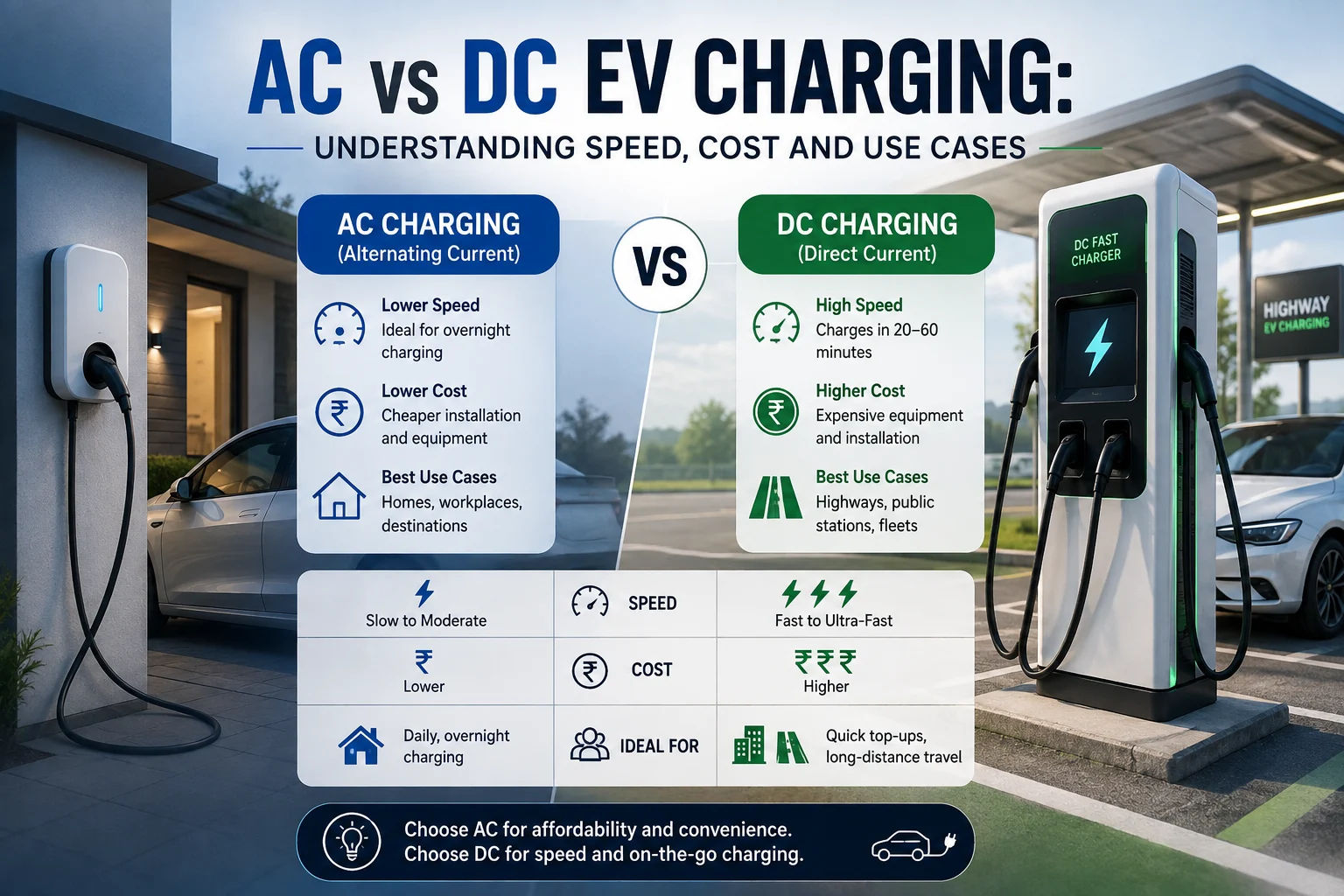
AC and DC charging are the two main approaches used to charge electric vehicles, but they are designed for different charging situations. Choosing between them is not simply a question of which one is faster. The right option depends on where the charger will be installed, how long vehicles remain parked, what type of drivers will use it, how much electrical capacity is available and how the charging station will operate.
For a housing society, an office or a hotel where vehicles may remain parked for several hours, AC charging can be a practical solution. For highways, busy commercial locations and fleet operations where vehicles need a faster turnaround, DC charging can be more appropriate.
Understanding the difference between AC and DC EV charging can help property owners and charging operators avoid investing in hardware that does not match the actual use case.
What Is AC EV Charging?
AC stands for alternating current. The electricity supplied from the grid is AC, and when an EV uses an AC charger, the vehicle’s onboard charger converts that AC electricity into the DC power required by the battery.
Because the conversion happens inside the vehicle, the charging speed is influenced not only by the AC charger’s rating but also by the vehicle’s onboard charger. This means that installing a higher-rated AC charger does not necessarily mean every vehicle will charge at that maximum rate.
AC charging is particularly useful when a vehicle can remain parked for an extended period. Overnight residential charging is a good example: the vehicle does not need to receive a large amount of energy in a few minutes because it has several hours available.
What Is DC EV Charging?
DC stands for direct current. With DC fast charging, the conversion from AC to DC happens within the charging equipment before electricity is delivered to the vehicle’s battery.
This allows DC chargers to provide significantly higher charging power than typical AC installations and can reduce the time required for a charging session. That makes DC charging useful where drivers cannot or do not want to remain parked for several hours.
DC charging is commonly considered for highway locations, busy commercial sites, fleet depots, fuel-station-style locations and other sites where vehicle turnaround is important.
AC vs DC EV Charging: The Basic Difference
| Factor | AC Charging | DC Charging |
|---|---|---|
| Power type delivered to vehicle | AC supplied to vehicle; vehicle converts it to DC | DC supplied directly to the battery |
| Typical charging speed | Slower than DC fast charging | Faster charging and shorter turnaround |
| Best suited for | Longer parking durations | Shorter stops and high vehicle turnover |
| Common locations | Homes, housing societies, offices, hotels | Highways, fleets, busy commercial locations |
| Electrical demand | Generally lower than high-power DC | Generally higher, depending on charger capacity |
| Primary advantage | Practical for extended parking | Fast turnaround |
Why Charging Speed Is Not the Only Factor
It is easy to assume that a faster charger is always the better charger. In practice, charging speed only matters when the location and users actually need it.
If a car arrives at a housing society at 8 PM and remains parked until 7 AM, there may be little reason to prioritise extremely high charging power. A reliable AC charger can use the long parking window effectively.
Now consider a highway driver who has stopped for a short break. Waiting several hours would not be practical. In that situation, DC fast charging can provide much greater value because reducing charging time directly improves the driver’s journey.
The right question is therefore not “Which technology is better?” but “Which technology fits the way vehicles use this location?”
AC Charging: Where Does It Work Best?
AC charging is a strong fit for locations where vehicles naturally remain parked for longer periods. This includes residential buildings, housing societies, offices, hotels, educational campuses and some workplace or destination-charging environments.
For a housing society, residents generally return home and leave their vehicles parked overnight. The charging system can therefore be designed around long dwell times rather than rapid turnaround.
At an office, employees may leave their vehicles parked throughout the working day. Hotels can offer AC charging to guests whose vehicles remain on the property for several hours or overnight.
AC charging can also make sense where the operator wants to provide charging to multiple parking spaces over time and expand the network according to actual demand.
DC Charging: Where Does It Work Best?
DC charging becomes more attractive when charging speed is a major part of the user experience. Highway charging is the clearest example. Drivers travelling between cities generally want to spend as little time as practical at a charging stop.
DC charging can also be useful for fleet depots, busy commercial properties and locations where vehicles have short parking windows.
Fleet operators may have a particularly strong reason to consider DC because vehicle availability directly affects operations. However, the required charger capacity should be determined from fleet schedules, battery sizes, charging windows, daily utilisation and available electrical infrastructure.
Understanding the Cost Difference
AC and DC charging should not be compared only by the purchase price of the charger. The total project cost can include electrical upgrades, cabling, protection equipment, civil work, installation, software, connectivity, maintenance and ongoing energy-related costs.
High-power DC installations can require more substantial electrical infrastructure because the site needs to support significantly greater power demand. Depending on the location, this can make the overall project more complex.
AC installations can often be simpler for lower-power, longer-dwell applications, but the actual cost still depends on the site and charger specification.
For a business evaluating an EV charging project, the better approach is to compare the complete installed solution rather than looking at the charger price alone.
Power Rating Does Not Equal Actual Charging Speed
A charger’s advertised power rating is only one part of the charging equation. The vehicle also has limits on how much power it can accept, and charging behaviour can change during a session.
For AC charging, the vehicle’s onboard charger is an important factor. For DC charging, the vehicle’s battery system and charging curve determine how much power can be accepted at different stages of the session.
This is why a charger with a larger power rating does not automatically mean every EV will charge at that maximum level.
Electrical Infrastructure: The Part You Should Not Ignore
Before installing either AC or DC chargers, the property’s electrical infrastructure should be assessed. This includes available capacity, distribution equipment, cabling, protection, earthing and the proposed charger locations.
The assessment becomes especially important when multiple chargers are installed. A site may be able to support one charger comfortably but face a very different load requirement when several vehicles charge simultaneously.
For larger charging networks, load management can help coordinate available power across chargers. This can be particularly useful when the site has a defined electrical limit that should not be exceeded.
AC vs DC for Housing Societies
Housing societies are one of the clearest examples of where use case should drive charger selection. Vehicles may remain parked overnight, meaning the charging window can be long.
AC chargers can therefore provide a practical residential charging option. The society can evaluate dedicated charging points, shared charging areas or a combination depending on the parking arrangement.
DC charging can still have a role where residents need rapid top-ups or where the society wants to provide a faster shared charging facility. However, the additional electrical requirements and expected utilisation should be evaluated before making that investment.
The society should also consider how electricity costs will be recovered, how users will access chargers, how charging sessions will be monitored and how additional chargers will be added as EV ownership grows.
AC vs DC for Offices and Commercial Buildings
Office buildings often have a useful charging window because employees may remain at work for several hours. AC charging can therefore be a suitable workplace option.
Commercial properties such as malls, hotels and mixed-use developments may have more varied parking behaviour. Some visitors may stay for an hour, while others may remain for several hours.
In these cases, a mixed charging strategy can be considered. AC chargers can support longer-stay users while DC chargers can serve drivers who prioritise faster charging.
AC vs DC for Highways
Highway charging is fundamentally different from residential charging. Drivers are travelling to a destination and generally want to minimise the time spent stopped.
DC fast charging is therefore typically more suitable for highway use because it supports faster turnaround. However, the charger is only one component of a successful highway station.
Operators should also consider electrical connection, number of charging points, traffic volume, parking layout, entry and exit routes, visibility, signage, driver amenities, maintenance access and remote monitoring.
Vehicle and Connector Compatibility
Before purchasing charging hardware, operators should check the EVs expected to use the station and confirm the relevant connector requirements.
Weej Wala lists Type 2 connectors for its AC charging range and CCS2 and CHAdeMO support for its listed DC charging range. Operators should still confirm the current requirements of the vehicles and the selected charger configuration before installation.
Compatibility should be considered alongside power rating, communication capabilities and software integration. A charger is useful only when the vehicles using the location can access it reliably.
When Does a Mixed AC + DC Installation Make Sense?
Some locations have more than one type of charging requirement. A shopping centre, hotel, large commercial complex or destination charging site may serve both long-stay and short-stay users.
In these situations, combining AC and DC chargers can provide flexibility. AC chargers can serve users who are staying longer, while DC chargers can support customers who need a quicker top-up.
A mixed installation should still be planned around the site’s total electrical capacity. The objective is not to install every available charger type, but to create a charging mix that matches actual demand.
How Software Changes the Charging Experience
Modern charging infrastructure increasingly depends on software as well as hardware. Operators need to know whether chargers are available, whether sessions are active, how much energy is being consumed and whether faults have occurred.
Connected charging systems can support monitoring, diagnostics, session management, energy reporting and user management. Weej Wala describes IONAGE Nexus as a station-management platform and the IONAGE app as a driver-facing service for station discovery, route planning, charging and payment.
For operators managing multiple chargers, this operational layer can make it easier to understand utilisation and identify issues that require attention.
Maintenance Is Important for Both AC and DC
Installing a charger is not the end of the project. Charging equipment needs ongoing maintenance and monitoring to remain reliable.
Operators should plan for physical inspections, connector and cable checks, communication monitoring, fault handling and preventive maintenance. Remote monitoring can help identify issues, but it does not eliminate the need for on-site support.
A reliable charging station is ultimately a combination of good hardware, proper installation, monitoring and ongoing maintenance.
How to Decide Between AC and DC
Choose AC when:
- Vehicles remain parked for several hours.
- Overnight or workplace charging is expected.
- Fast turnaround is not the primary requirement.
- The site is residential, office-based or hospitality-focused.
- You want to build charging capacity progressively.
Consider DC when:
- Drivers need faster charging.
- Parking duration is relatively short.
- Vehicle turnover is high.
- The location serves highway or intercity traffic.
- A fleet needs vehicles back in operation quickly.
Consider AC + DC when:
- The location serves different user groups.
- Some vehicles stay for hours while others need quick top-ups.
- The site has sufficient electrical infrastructure.
- There is enough demand to justify multiple charging types.
A Simple Checklist Before Installing an EV Charger
- Identify the target users.
- Measure typical parking or dwell time.
- Estimate current and future EV demand.
- Assess available electrical capacity.
- Determine whether AC, DC or mixed charging is appropriate.
- Confirm vehicle and connector compatibility.
- Plan charger locations and cable routes.
- Consider load management for multiple chargers.
- Choose charging software and connectivity.
- Define payment and access requirements.
- Plan maintenance and fault support.
- Review safety and emergency access.
- Allow for future charger expansion.
Final Takeaway
AC and DC charging are not competing technologies where one is universally better than the other. They solve different charging problems.
AC charging is often the logical choice when vehicles remain parked for longer periods, making it well suited to homes, housing societies, offices and hotels. DC charging is more appropriate when faster turnaround matters, such as on highways, at busy commercial locations and in certain fleet applications.
The most important decision is to understand the location first. Look at parking duration, users, electrical capacity, vehicle compatibility, operating costs, software requirements and future demand before selecting the charger.
The right EV charging solution is not necessarily the fastest one. It is the one that fits the way the location actually operates.
Frequently Asked Questions
Is AC or DC charging better?
Neither is universally better. AC is often better for longer parking durations, while DC is better when faster turnaround is important. The right choice depends on the location and its users.
Is AC charging suitable for housing societies?
Yes. AC charging can be well suited to housing societies because vehicles often remain parked for several hours or overnight. The final charger rating should be selected based on vehicle requirements and available electrical capacity.
Is DC charging better for highways?
DC fast charging is generally more suitable for highway locations because drivers typically want to minimise charging time and continue their journey.
Can a property use both AC and DC chargers?
Yes. A mixed installation can serve users with different parking durations and charging requirements, provided the site’s electrical infrastructure and operating model support it.
Does a higher-power charger always mean faster charging?
No. Actual charging speed depends on the vehicle’s charging capability, the charger, battery conditions and other factors. A charger cannot force a vehicle to accept more power than its charging system allows.
What should I check before installing an EV charger?
Assess parking duration, vehicle types, electrical capacity, charger location, connector compatibility, access, safety, software, payments, maintenance and future expansion requirements.
What is the main advantage of DC fast charging?
The main advantage is faster charging and shorter vehicle turnaround. This makes DC particularly useful where drivers cannot remain parked for several hours.
Planning an EV charging project? Start with the site, understand the users and then select the AC, DC or combined charging solution that fits your property’s actual requirements.