

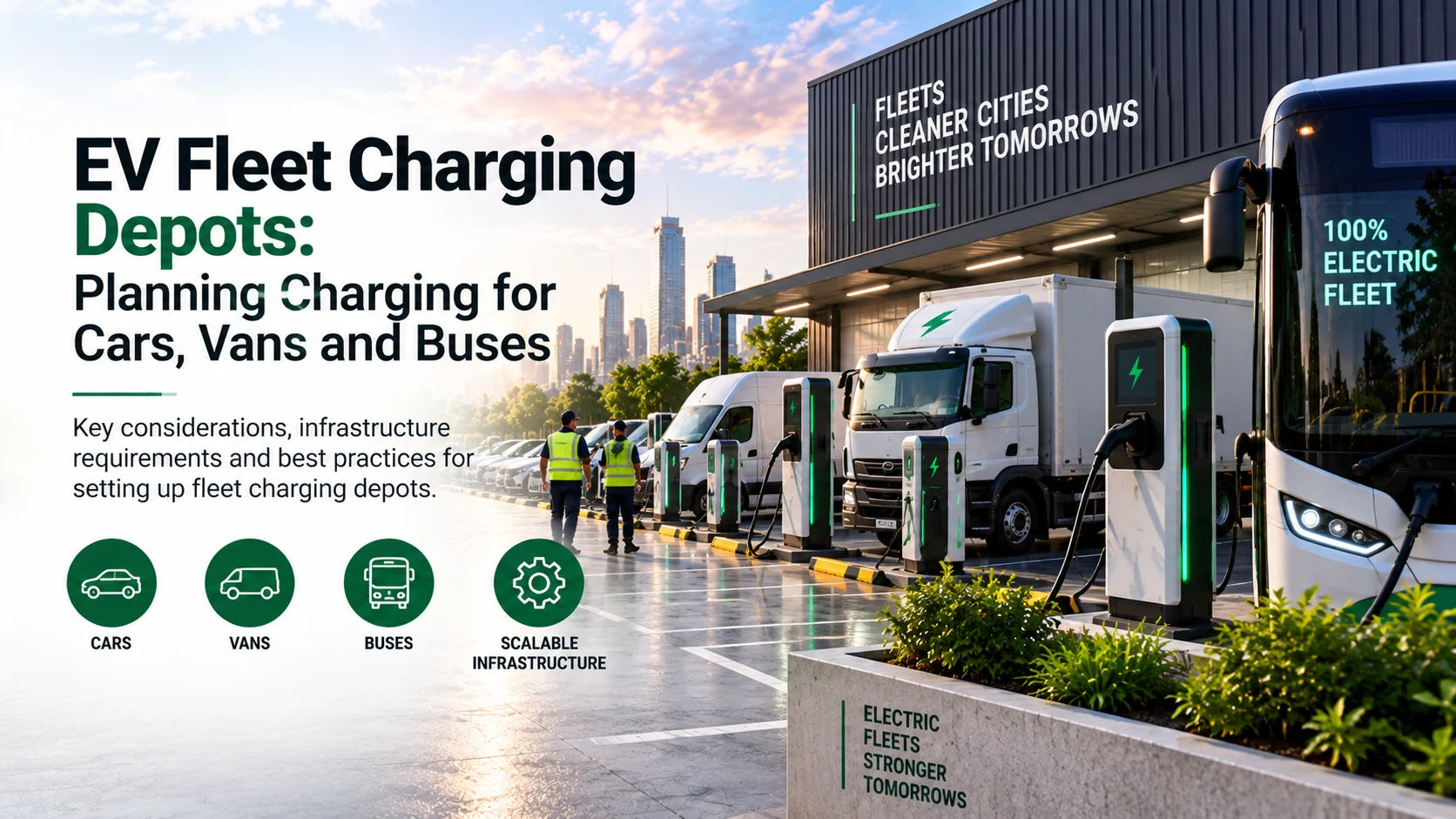
Fleet electrification changes more than the vehicles themselves. When cars, vans and buses move from petrol or diesel to electric, the depot becomes an important part of the operating system. Vehicles need to return, park, charge, and be ready for their next assignment without disrupting daily schedules.
That makes EV fleet charging depot planning a practical infrastructure and operations challenge. A depot may need to charge a small number of electric cars today and a much larger fleet later. The charging strategy therefore needs to consider vehicle schedules, daily energy requirements, dwell time, charger type, electrical capacity, parking layout, power management, maintenance and future expansion.
This guide explains how fleet operators can approach depot charging for electric cars, vans and buses and what to review before selecting equipment or finalizing the site design.
What Is an EV Fleet Charging Depot?
An EV fleet charging depot is a dedicated location where electric fleet vehicles are parked and charged between operating periods. Depending on the business, the depot could support company cars, delivery vans, taxis, buses, employee transport vehicles, service vehicles or other commercial fleets.
Unlike a public charging station, a fleet depot is generally designed around the operator’s own vehicles and schedules. The key question is not simply how fast a charger can charge a vehicle, but whether the charging system can reliably prepare the required vehicles for their next routes.
Why Fleet Charging Requires Different Planning
A public charging station may have unpredictable customer demand. A fleet depot often has more structured operating patterns.
For example, a delivery fleet may return to the depot throughout the afternoon and evening and leave again early the next morning. A city bus fleet may have scheduled return windows, while service vehicles may remain parked overnight.
This makes vehicle scheduling one of the most important inputs into depot charging design.
Start With the Fleet, Not the Charger
A common mistake is to choose chargers first and then try to fit the fleet around them. A better approach is to understand the vehicles and their operating requirements first.
Collect information such as:
- Number of vehicles
- Vehicle type
- Battery capacity
- Typical daily energy consumption
- Daily distance
- Arrival times
- Departure times
- Typical parking duration
- Required state of charge at departure
- Vehicle charging capability
- Route and operational priorities
This information provides the foundation for deciding how many chargers are needed and what type of charging is appropriate.
Plan Around Daily Energy Requirements
Fleet charging demand should be based on the energy vehicles actually need rather than only on their battery size.
A vehicle with a large battery may return to the depot with a substantial amount of charge remaining, while another vehicle may need significantly more energy because of a longer route.
Estimate the energy required per vehicle and then build a fleet-level profile. This helps determine when charging demand occurs and how much energy the depot needs to deliver during available charging windows.
Understand Dwell Time
Dwell time is the amount of time a vehicle remains parked at the depot and is potentially available for charging.
This is a critical factor when selecting charger power.
A vehicle parked for eight hours overnight may not need the same charging power as a vehicle that returns for only one hour before its next route.
For fleet planning, ask:
- How long is each vehicle normally parked?
- Which vehicles have the shortest charging windows?
- Which vehicles can charge overnight?
- Are there opportunities for daytime charging?
- Do vehicles return at the same time or throughout the day?
Choosing AC or DC Charging for Fleets
AC Charging
AC charging can be suitable when vehicles remain parked for longer periods. It may work well for company cars, some delivery fleets and vehicles that spend extended periods at the depot.
AC charging can also allow operators to distribute charging over a longer period instead of requiring maximum charging power immediately.
DC Fast Charging
DC fast charging can be useful where vehicles have short turnaround times or need a significant amount of energy before returning to service.
This can be relevant for buses, high-utilization delivery fleets, commercial vehicles and other operations where vehicles cannot remain parked for long periods.
DC systems can involve higher equipment and electrical infrastructure requirements, so their business case should be connected directly to the fleet’s operating schedule.
Cars, Vans and Buses Have Different Charging Needs
Electric Cars
Fleet cars often have relatively flexible charging windows. If they are parked overnight or throughout the workday, AC charging can be appropriate depending on vehicle requirements and site capacity.
Electric Vans
Delivery and service vans can have more demanding schedules. Their charging strategy should account for route distance, delivery windows, payload, daily mileage and the time available between shifts.
Electric Buses
Buses can require substantial energy because of their operating patterns, vehicle size and daily mileage. Depot planning may need to consider high-power charging, scheduled charging windows, route priorities and the number of vehicles returning simultaneously.
For buses, the charging strategy should be developed together with route schedules and depot operations rather than treating each charger as an isolated asset.
Calculate the Depot’s Charging Capacity
Once the fleet requirements are known, estimate how much charging capacity the depot needs.
A basic planning approach is to consider:
- Total daily energy required
- Available charging hours
- Number of vehicles charging simultaneously
- Charger output
- Vehicle charging acceptance
- Charging losses
- Site electrical capacity
The goal is to make sure the depot can deliver the required energy during the available windows without unnecessarily oversizing the charging system.
Why Simultaneous Charging Matters
If many vehicles return at the same time, charging demand can rise quickly. For example, a depot with 20 chargers may have a very different electrical requirement depending on whether two vehicles or all 20 are charging simultaneously.
Fleet operators should model realistic arrival and departure patterns rather than assuming that every charger will always operate at maximum output.
Use Smart Charging and Load Management
Smart charging can help coordinate available power across multiple vehicles. Instead of treating every vehicle equally at every moment, the system can allocate charging power according to site capacity and operational requirements.
For example, vehicles leaving early the next morning may receive a higher priority than vehicles scheduled to remain parked longer. The exact control logic depends on the charging system and fleet-management requirements.
Load management can also help keep the combined EV charging load within a defined site limit, particularly when the depot has other electrical loads.
Set Charging Priorities
Fleet depots often need more sophisticated charging priorities than residential or destination charging sites.
Possible priority factors include:
- Next departure time
- Required state of charge
- Route distance
- Vehicle operational importance
- Available charging time
- Current battery state
Priorities should be based on actual business requirements. A vehicle needed for an early morning route may need to be charged before another vehicle that will not leave until later.
Plan the Depot Electrical Infrastructure
Charging hardware is only one part of a fleet depot. Electrical infrastructure needs to support the intended charging system safely and reliably.
Depending on the project, the design may involve:
- Electrical distribution equipment
- Cabling
- Protection equipment
- Metering
- Load-management equipment
- Transformer or connection upgrades where required
- Earthing and other electrical provisions
The required infrastructure should be determined through an appropriate electrical assessment and engineering design.
Consider the Depot’s Existing Loads
Fleet charging may share the electrical connection with offices, workshops, lighting, HVAC, pumps, equipment and other loads.
Understanding the existing load profile can help determine when charging demand can be accommodated and when power management may be required.
Operators should examine both the total available capacity and the timing of existing electrical demand.
Design the Parking Layout Around Charging
The physical arrangement of vehicles and chargers can affect depot efficiency.
Consider:
- Vehicle parking direction
- Charger placement
- Cable reach
- Traffic flow
- Turning radius
- Pedestrian movement
- Emergency access
- Maintenance access
- Future charger locations
A charger should be positioned so that drivers can connect vehicles without creating unnecessary congestion or requiring awkward vehicle movements.
Separate Charging From Vehicle Operations Where Appropriate
A depot is a working environment, not simply a parking lot. Charging infrastructure should fit into vehicle inspection, loading, cleaning, maintenance and dispatch activities.
For example, placing chargers in a location that blocks vehicle movement during busy dispatch periods can create operational problems even if the electrical design is adequate.
Map the complete vehicle journey through the depot before finalizing charger locations.
Plan for Safety and Site Operations
Fleet charging infrastructure should be incorporated into the site’s broader electrical, fire-safety, traffic and operational planning.
Consider clear access routes, appropriate protection for charging equipment, cable management, vehicle movement, emergency access and relevant site procedures.
Electrical installation and safety requirements should be reviewed by appropriately qualified professionals and according to applicable local requirements.
Charging Schedule Example
Consider a simplified fleet with vehicles returning between 6 PM and 10 PM and departing between 5 AM and 8 AM.
Instead of immediately charging every vehicle at maximum power when it arrives, the operator could use the available overnight window to distribute charging across the fleet.
Vehicles leaving at 5 AM could receive higher priority, while vehicles leaving later could be scheduled for later charging. If site demand is low during part of the night, available charging power could potentially be used more efficiently during those periods.
This illustrates why charging schedules should be designed around vehicle operations rather than only charger specifications.
Monitor Fleet Charging Performance
Once the depot is operating, data can help determine whether the charging strategy is meeting fleet requirements.
Useful metrics include:
- Energy delivered per vehicle
- Charging sessions per day
- Average charging duration
- Peak depot charging load
- Charger utilization
- Vehicle departure state of charge
- Charging failures
- Charger uptime
- Energy cost
- Vehicles requiring manual intervention
These metrics can show whether vehicles are consistently ready for dispatch and whether the charging infrastructure is being used efficiently.
Track Vehicle Readiness, Not Just Charger Usage
A charger can have high utilization and still fail to meet the fleet’s operational needs. The more important question for many fleet operators is whether the required vehicles are ready when they need to leave.
Vehicle readiness can therefore be a key operational KPI. Operators can compare planned departure times with the actual state of charge available at dispatch.
This helps connect charging infrastructure performance with the fleet’s core business operation.
Plan for Charging Downtime
Fleet depots often depend heavily on their charging infrastructure. A failed charger can affect vehicle availability, particularly when there are few spare charging points.
Operators should consider redundancy during planning. If one charger is unavailable, can another charger serve the vehicle? Can charging sessions be moved to another bay? Are there backup operating procedures?
The appropriate level of redundancy depends on fleet size, vehicle schedules, charger configuration and operational risk.
Maintenance and Reliability
Fleet charging equipment should be included in the depot’s maintenance program. Regular inspection and monitoring can help identify issues before they become prolonged outages.
Useful practices can include:
- Monitoring charger status remotely
- Tracking recurring faults
- Inspecting cables and connectors
- Following manufacturer maintenance guidance
- Maintaining appropriate spare parts where justified
- Recording repair history
- Reviewing charger uptime
Maintenance requirements should reflect the specific equipment, operating environment and manufacturer’s instructions.
Plan for Future Fleet Growth
Fleet electrification often happens in stages. An operator may begin with a small number of electric vehicles and gradually expand.
Depot planning should therefore consider the future state of the fleet. Questions include:
- How many vehicles may be electrified over the next few years?
- Will vehicle types change?
- Will more DC charging be required?
- Can existing electrical infrastructure support additional chargers?
- Is there space for additional parking bays?
- Can cable routes and distribution equipment be expanded?
- Can the charging-management system support more vehicles?
Planning expansion does not necessarily mean installing all future chargers immediately. It means understanding what would be required if demand grows.
Consider Total Cost of Ownership
The lowest charger purchase price does not necessarily represent the lowest long-term operating cost.
Fleet operators should consider:
- Hardware cost
- Installation
- Electrical upgrades
- Software and network costs
- Energy costs
- Maintenance
- Downtime impact
- Replacement costs
- Future expansion
Comparing total cost of ownership can provide a more complete view of different charging approaches.
Consider Energy and Charging Costs Together
Energy consumption is a major operating cost for electric fleets. Operators should model how much energy vehicles require and when charging occurs.
Where applicable, charging schedules can be designed to take advantage of periods when electricity costs are lower, provided the approach remains compatible with vehicle schedules and applicable tariffs.
The charging strategy should never compromise required vehicle readiness simply to reduce energy cost.
Common Fleet Charging Depot Mistakes
Choosing Chargers Before Understanding Routes
Charger selection should follow an understanding of vehicle schedules, energy requirements and dwell time.
Ignoring Simultaneous Charging
Planning around one vehicle at a time can underestimate the electrical and operational requirements of a busy depot.
Oversizing Every Charger
Maximum charging power is not always necessary when vehicles have long parking windows.
Ignoring Vehicle Departure Times
A charging schedule that does not account for dispatch times can leave vehicles insufficiently charged when they are needed.
Not Planning Redundancy
Depending on the fleet, losing one charger can affect several vehicle schedules. Backup options should be considered during design.
Forgetting Future Expansion
A depot may operate efficiently today but become constrained as the electric fleet grows. Expansion requirements should be considered early.
EV Fleet Charging Depot Planning Checklist
- How many electric vehicles will the depot support?
- What types of vehicles will be charged?
- What is the daily energy requirement?
- What are the arrival and departure times?
- How long is each vehicle parked?
- Which vehicles have the highest charging priority?
- Which vehicles require AC charging?
- Which vehicles may require DC fast charging?
- How many vehicles may charge simultaneously?
- What electrical capacity is available?
- What other site loads operate at the depot?
- Is smart charging or load management required?
- Is the parking layout compatible with charger placement?
- Is there sufficient maintenance and emergency access?
- What level of charger redundancy is appropriate?
- How will charger uptime be monitored?
- What vehicle-readiness KPI will be tracked?
- How will the depot support future fleet growth?
Conclusion
EV fleet charging depot planning should begin with the fleet’s operating requirements rather than the charger catalogue. Cars, vans and buses can have very different energy needs, dwell times, routes and departure schedules, so a single charging strategy may not suit every vehicle.
By mapping vehicle schedules, estimating daily energy requirements, selecting appropriate AC or DC charging, managing simultaneous loads, planning the electrical infrastructure, optimizing the parking layout and monitoring vehicle readiness, fleet operators can build a charging system around actual operations.
For Weej Wala partners, the same approach can support fleet electrification across delivery operations, corporate vehicles, buses, service fleets and other commercial applications. The objective is straightforward: make sure the right vehicles receive the energy they need, when they need it, while keeping the depot safe, manageable and ready for future growth.
Frequently Asked Questions
What is an EV fleet charging depot?
An EV fleet charging depot is a dedicated site where electric fleet vehicles are parked and charged between operating periods. It can support cars, vans, buses and other commercial vehicles.
How do I determine how many chargers a fleet depot needs?
Start with the number and type of vehicles, daily energy requirements, arrival and departure times, dwell time, vehicle charging capability and the number of vehicles that may need to charge simultaneously.
Should fleet depots use AC or DC chargers?
The choice depends on vehicle requirements and charging windows. AC can suit vehicles with longer dwell times, while DC charging can be useful where vehicles need significant energy during shorter turnaround periods.
Why is smart charging useful for fleet depots?
Smart charging can coordinate charging across multiple vehicles and distribute available electrical capacity according to site limits and operational priorities.
What is the most important fleet charging KPI?
There is no single KPI for every fleet. Vehicle readiness, energy delivered, charging failures, charger uptime, utilization and energy cost can all be useful depending on the fleet’s operating objectives.
Should a fleet depot be designed for future expansion?
Yes. Operators should consider future vehicle numbers, electrical capacity, charger locations, cable routes, parking space and charging-management capabilities even if the initial installation is smaller.