

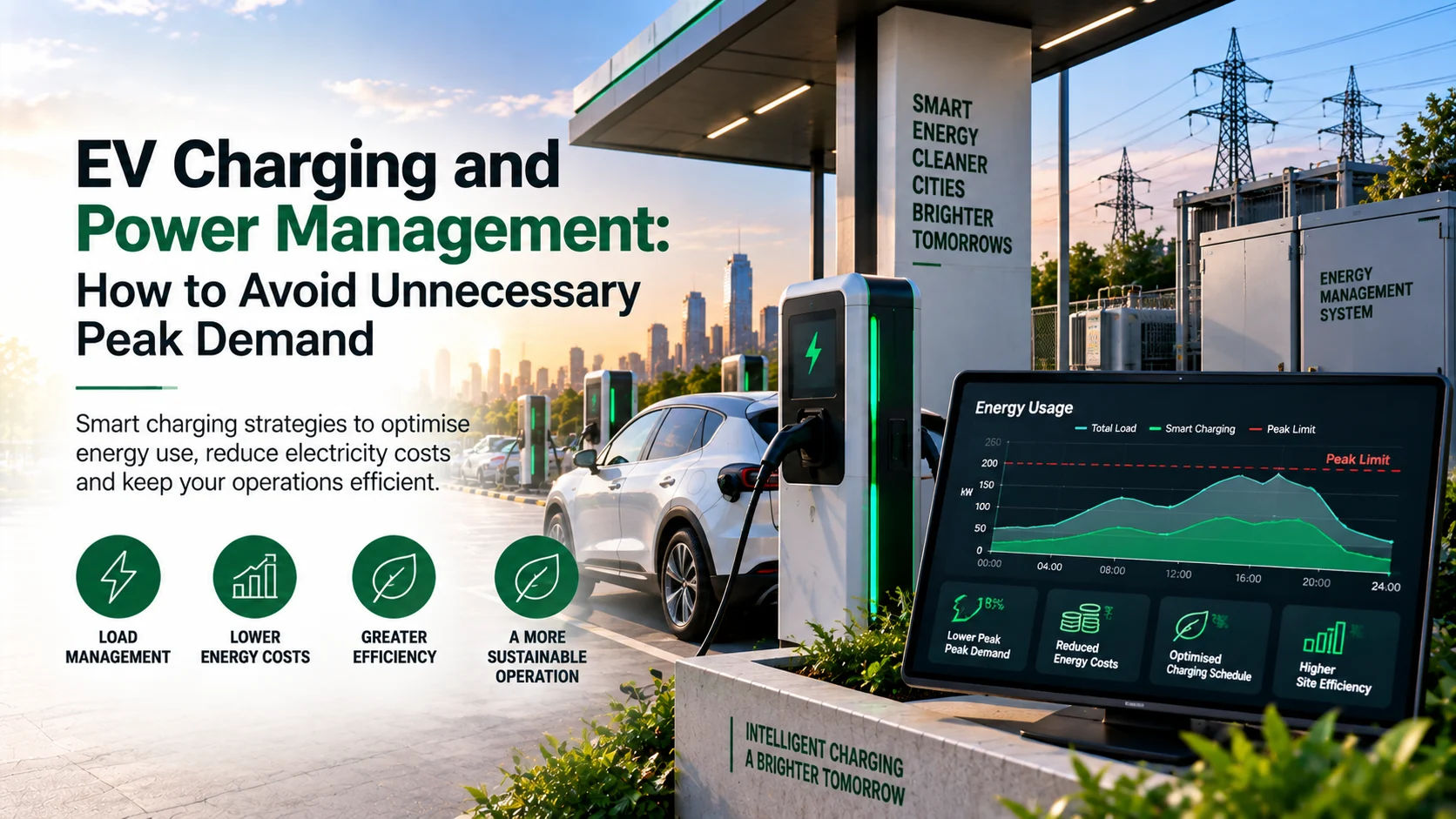
EV charging can add a significant electrical load to a property, especially when multiple vehicles charge at the same time. For a charging operator, office, housing society, commercial property, fleet depot or highway site, the challenge is not only installing enough chargers. It is also managing available electrical capacity efficiently.
This is where EV charging power management becomes important. Instead of allowing every connected charger to draw its maximum available power at the same time, a power-management strategy can coordinate charging according to site capacity, vehicle requirements and other electrical loads.
Good power management can help operators reduce unnecessary peak demand, make better use of existing electrical infrastructure and plan charging capacity more effectively. It can also provide a path to expanding EV charging without automatically assuming that the site’s entire electrical system must be upgraded for maximum simultaneous charger output.
What Is EV Charging Power Management?
EV charging power management is the process of controlling and distributing available electrical power among EV chargers and other site loads. The system monitors available capacity and can adjust charger output so that the charging network operates within defined electrical limits.
For example, imagine a property has several EV chargers but also has lifts, air-conditioning systems, lighting, pumps and other equipment operating at the same time. If all EV chargers suddenly begin drawing their maximum power, the combined demand may become unnecessarily high.
A power-management system can respond by allocating charging power according to the available capacity rather than treating every charger as an independent maximum-load device.
Why Peak Demand Matters
Electricity costs are not always determined only by the number of units of energy consumed. Depending on the applicable tariff and connection, demand-related charges or other structures can make periods of high electrical demand important to the site’s overall energy economics.
Even where demand charges are not the main concern, a sudden increase in load can put pressure on electrical infrastructure. Managing charging demand can therefore be useful for both cost planning and operational reliability.
The important distinction is between energy consumption and power demand:
- Energy is the amount of electricity consumed over time, commonly measured in kWh.
- Power is the rate at which electricity is being used at a particular moment, commonly measured in kW.
A site can consume the same total amount of energy while having very different peak-demand profiles depending on when and how vehicles are charged.
How Multiple EV Chargers Create Peak Loads
Consider a parking facility with several AC chargers. If many vehicles connect around the same time, each charger may initially request a high level of power. The combined load can rise quickly.
The same principle can apply to DC fast-charging sites. Multiple high-power chargers operating simultaneously can create a substantial electrical demand, particularly if the site already has significant commercial or industrial loads.
This does not mean that simultaneous charging is always a problem. It means that the charging system should be designed around the site’s actual electrical capacity and expected operating pattern.
What Is Smart Load Management?
Smart load management dynamically distributes available power among charging points. Instead of assigning every charger a fixed maximum output at all times, the system can adjust charging power based on conditions at the site.
A simplified example:
- A site has 100 kW available for EV charging.
- Four vehicles are connected.
- Two vehicles are requesting high charging power.
- The remaining vehicles need less power or can tolerate a slower charge.
The management system can allocate the available capacity across the vehicles rather than allowing the combined charger demand to exceed the defined limit.
The exact allocation logic depends on the charging system and its configuration. Some systems can use charging priorities, site limits, vehicle requirements, session status or other operating rules.
Static vs Dynamic Load Management
Static Load Management
Static load management uses a predefined power limit. For example, an installation may be configured so that the charging network never exceeds a specified maximum capacity.
This approach can be straightforward to implement and can work well when the site’s available charging capacity is relatively predictable.
Dynamic Load Management
Dynamic load management adjusts charging capacity according to real-time site conditions. If the building’s other electrical loads increase, the charging system can reduce available EV charging power. When other loads decrease, more capacity may become available for EV charging.
This approach can make better use of available electrical capacity because the charging network is not necessarily restricted to the same fixed limit at every moment.
How EV Charging Power Management Can Reduce Unnecessary Peak Demand
1. Set a Site-Level Charging Limit
The first step is to establish how much power can safely and economically be allocated to EV charging. This limit should be based on the electrical design and operating requirements of the property rather than simply adding the maximum ratings of every charger.
2. Monitor the Building’s Existing Load
EV charging is only one part of a property’s electrical demand. A power-management strategy should consider significant loads already operating at the site.
For example, an office building may experience high electricity demand during working hours. A charging-management system can take those conditions into account when allocating power to EV chargers.
3. Distribute Available Power Across Chargers
When several vehicles are charging, available capacity can be distributed across the active sessions. The goal is to keep the overall charging load within the configured site limit while still delivering useful charging to connected vehicles.
4. Prioritize Charging When Necessary
Some sites may have different vehicle priorities. A fleet depot, for example, may need certain vehicles ready for an upcoming route. A workplace may have employees staying for several hours and therefore have more flexibility.
Charging priorities should reflect the site’s actual operational requirements.
5. Shift Flexible Charging
Not every vehicle needs maximum charging power immediately. Where dwell time permits, charging can be spread over a longer period instead of creating a large load in a short window.
This can be particularly relevant for offices, residential parking, hotels and fleet operations where vehicles remain parked for extended periods.
EV Charging Load Management for Housing Societies
Housing societies can face a unique challenge because multiple residents may return home and plug in their EVs during similar evening hours.
If every charger is allowed to operate at its maximum rating simultaneously, the combined charging load can become difficult to manage alongside normal residential electricity consumption.
A managed charging approach can distribute available capacity across connected vehicles. Residents can still charge their vehicles while the charging system works within the electrical constraints established for the property.
For societies planning future EV adoption, it is useful to consider power management before installing a large number of chargers. The charging infrastructure should be designed around both current demand and a realistic expansion plan.
Power Management for Offices
Office buildings often have predictable daytime load patterns. Air-conditioning, lifts, lighting, computers and other building systems may already create substantial demand.
Workplace EV charging can be managed around employee parking duration. Employees who remain parked for several hours may not require the full charger output throughout the entire parking period.
Instead of maximizing charging speed for every vehicle, an operator can use available electrical capacity to provide useful charging across more vehicles while respecting the site’s overall power limit.
Power Management for Fleet Depots
Fleet charging requires a different approach because vehicle availability can be tied directly to business operations.
A depot may need certain vehicles fully charged before a morning departure while other vehicles can charge later. A charging-management system can use operational priorities to allocate capacity according to vehicle schedules.
Fleet operators should consider:
- Vehicle departure times
- Required state of charge
- Route distance
- Available charging windows
- Number of vehicles
- Charger capacity
- Depot electrical capacity
Power Management for Commercial and Public Charging
Public charging locations can experience unpredictable demand. Several vehicles may arrive during a busy period, while demand may be much lower at other times.
For such locations, operators can evaluate the relationship between charger capacity, grid capacity and expected utilization. Power management can help maintain a defined site limit when multiple charging sessions overlap.
For DC fast-charging sites, this can be especially relevant when multiple high-power chargers are installed at a location with a finite grid connection.
Why Charger Ratings Should Not Be Added Blindly
A common planning mistake is to add the maximum rated power of every charger and assume the site’s electrical infrastructure must support that number continuously.
For example, ten 22 kW AC chargers have a combined nameplate capacity of 220 kW. That does not necessarily mean the site will continuously consume 220 kW for EV charging. Actual demand depends on how many vehicles are connected, how much power each vehicle can accept, charging behavior and the site’s load-management strategy.
At the same time, operators should not use load management as a reason to ignore electrical design requirements. The installation still needs to be engineered for safe and compliant operation, including appropriate protection and capacity for the intended system.
Understand the Difference Between Charger Power and Vehicle Acceptance
A charger may be rated for a particular output, but the vehicle determines how much power it can actually accept under current conditions.
For AC charging, the vehicle’s onboard charger is an important factor. For DC charging, the vehicle’s battery system and charging curve affect the power it can accept.
As a result, the maximum charger rating is not always the same as the actual power delivered during a session. This is another reason to use realistic charging profiles when evaluating site capacity.
Peak Demand Reduction Does Not Mean Slowing Every Vehicle
The purpose of power management is not necessarily to charge every vehicle as slowly as possible. It is to use available power intelligently.
For example, if a site has unused capacity at one moment, charging power can be increased. If the building’s load rises, charging output can be reduced or redistributed.
The result can be a more flexible charging operation where available electrical capacity is matched to real-time conditions.
Data to Monitor
A charging-management strategy becomes more useful when operators can see what is happening at the site.
Useful measurements can include:
- Total site power demand
- EV charging power
- Power per charger
- Number of active sessions
- Energy delivered
- Peak charging periods
- Charger availability
- Historical load profiles
Analyzing this information over time can help operators identify recurring peaks and understand whether additional charging capacity is justified.
How to Plan an EV Charging Power Management Strategy
Step 1: Understand Existing Electrical Capacity
Start with the site’s existing electrical infrastructure and available capacity. The final electrical design should be based on appropriate professional assessment.
Step 2: Map Existing Loads
Identify major electrical loads and determine when they typically operate. This creates a baseline against which EV charging demand can be evaluated.
Step 3: Estimate EV Charging Demand
Estimate the number of vehicles, charging sessions, dwell times and likely energy requirements. Use realistic scenarios rather than assuming every charger will operate at maximum power simultaneously.
Step 4: Define a Charging Power Limit
Set a practical site-level limit based on the electrical design, operating requirements and business objectives.
Step 5: Select the Appropriate Management Method
Determine whether static allocation, dynamic load management or another control strategy fits the site.
Step 6: Monitor and Adjust
After deployment, compare actual charging behavior with the original assumptions. Use operating data to refine charging limits and expansion plans where appropriate.
Planning for Future Charger Expansion
Power management can be particularly valuable when a site expects the number of EVs to increase over time.
Instead of designing the first installation around the maximum theoretical load of every future charger, operators can plan electrical infrastructure and charging controls together. This can provide a structured path for adding chargers while keeping the site’s operating limits visible.
Future expansion should still be assessed by qualified electrical professionals. Load management is a control strategy, not a replacement for appropriate electrical infrastructure.
Common Power Management Mistakes
Ignoring Existing Building Loads
Looking only at EV chargers can produce an incomplete picture. The site’s normal electrical demand needs to be considered.
Assuming Maximum Charger Output Equals Actual Demand
Nameplate power is useful for electrical design, but real charging demand depends on vehicle behavior, session timing and charging controls.
Using One Fixed Assumption for Every Site
A housing society, office, highway stop and fleet depot have different operating patterns. Their charging-management strategies should reflect their actual use cases.
Not Monitoring After Installation
A business case and electrical plan are based on assumptions. Once the station is operating, real data should be used to verify those assumptions.
Treating Power Management as a Substitute for Electrical Design
Load management can optimize how available capacity is used, but it does not remove the need for proper electrical engineering, protection, installation and compliance.
EV Charging Power Management Checklist
- What is the site’s available electrical capacity?
- What are the property’s existing peak loads?
- How many EV chargers are planned?
- What are the charger ratings?
- What charging power can vehicles actually accept?
- How long do vehicles typically remain parked?
- When is EV charging demand expected to peak?
- Can charging be distributed across a longer dwell period?
- Should the site use static or dynamic load management?
- What charging priorities are required?
- What site-level charging limit should be configured?
- What data will be monitored after launch?
- Can the system support future charger expansion?
Conclusion
EV charging and power management should be considered together when planning charging infrastructure. The objective is not simply to install as many high-power chargers as possible. It is to match charging demand with available electrical capacity and the way vehicles actually use the site.
By monitoring existing loads, setting appropriate charging limits, distributing available power, prioritizing important sessions and using real operating data, charging operators can reduce unnecessary peak demand and make more effective use of their electrical infrastructure.
For Weej Wala partners, power management can be an important part of planning scalable EV charging infrastructure across housing societies, offices, commercial properties, public charging locations, highway stops and fleet depots. A well-planned system can support today’s charging requirements while providing a clearer path for future expansion.
Frequently Asked Questions
What is EV charging power management?
EV charging power management controls how available electrical capacity is distributed among EV chargers and other site loads so the charging system operates within defined limits.
How can power management reduce peak demand?
It can distribute or adjust charging power so that multiple chargers do not unnecessarily draw their maximum output at the same time, particularly when other building loads are high.
What is dynamic load management?
Dynamic load management adjusts EV charging power according to changing site conditions, such as increases or decreases in the property’s other electrical loads.
Is power management useful for housing societies?
Yes. It can help manage simultaneous charging when multiple residents plug in vehicles during similar periods, while keeping charging within the electrical capacity established for the property.
Does load management replace electrical upgrades?
No. Load management is a control strategy. The charging installation still requires appropriate electrical design, protection, capacity and compliance for the intended system.
Can power management help with future EV charger expansion?
It can help operators plan how available capacity may be shared as more chargers are added, although future expansion still needs to be evaluated as part of the site’s electrical design.