

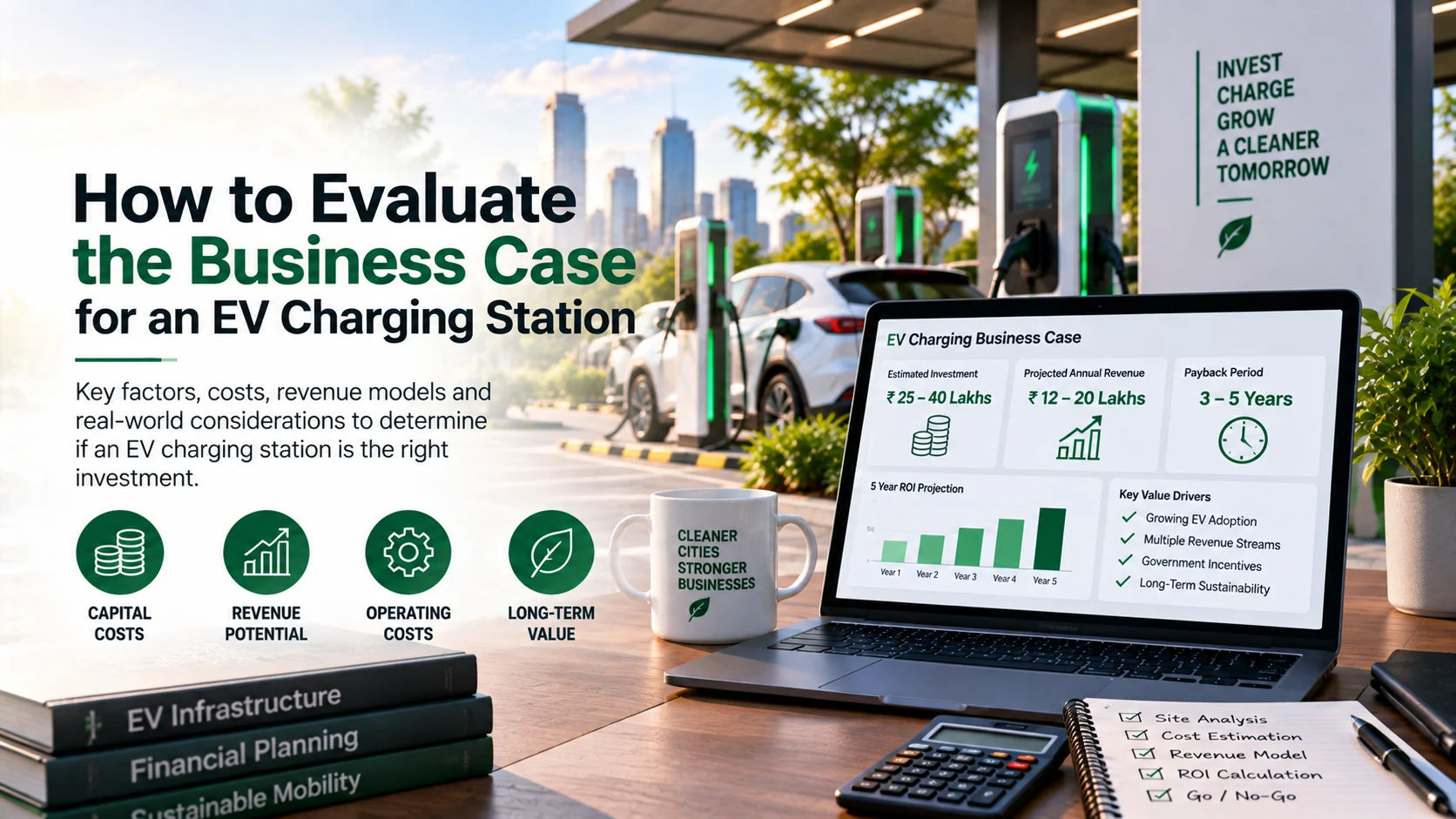
Installing an EV charging station is an infrastructure decision, but for a business, property owner or charging operator, it is also a financial decision. The right question is not simply, “How much does an EV charger cost?” A useful business case looks at the complete picture: expected charging demand, site characteristics, electricity costs, equipment and installation expenses, pricing, utilization, operating costs, revenue opportunities and the time required to recover the investment.
That makes EV charging station business case evaluation an important step before purchasing equipment or beginning installation. A location can have strong EV traffic and still require careful planning if electrical upgrades are expensive or utilization is uncertain. Similarly, a charger can become a valuable amenity for a property even when direct charging revenue is not the only objective.
This guide explains a practical framework for evaluating an EV charging station investment and identifying the numbers that matter before moving ahead.
Start With the Purpose of the Charging Station
Before calculating returns, define why the charging station is being installed. Different objectives can produce very different business cases.
- Public charging: The primary objective may be charging revenue from drivers.
- Destination charging: A hotel, mall, restaurant or other property may use charging to improve customer experience and encourage longer visits.
- Workplace charging: An employer may provide charging as an employee benefit or part of a sustainability program.
- Housing society charging: The focus may be resident convenience and shared infrastructure rather than maximizing commercial revenue.
- Fleet charging: A fleet operator may evaluate charging based on operating savings, vehicle availability and route requirements.
- Property value and differentiation: Charging infrastructure can support a property’s positioning as EV-ready.
Once the objective is clear, decide which financial and operational outcomes should be measured.
Estimate EV Charging Demand
Demand is one of the most important assumptions in an EV charging business case. A charger only generates meaningful charging revenue when it is actually used, so estimating utilization should come before making optimistic revenue projections.
Start by understanding the location:
- How many EVs already visit or are likely to visit the site?
- How many vehicles pass the location each day?
- Is the site near offices, housing, retail, hotels or highways?
- How long do customers normally remain at the property?
- Are there competing charging stations nearby?
- Is the location visible and easy to access?
- Will charging demand change as EV adoption increases?
It is useful to build multiple demand scenarios instead of relying on one forecast. For example, create conservative, expected and higher-utilization cases. This makes the business case more resilient to uncertainty.
Understand Charger Utilization
Utilization describes how much of the available charging capacity is actually being used. For an operator, this is a critical metric because equipment may remain available for many hours without generating revenue.
For example, two locations can have identical chargers and electricity costs but very different financial results if one location has consistently higher charging demand.
When estimating utilization, consider both the number of charging sessions and the energy delivered. A station with many short sessions is different from one where vehicles regularly consume large amounts of energy.
Calculate the Initial Investment
The purchase price of the charger is only one part of the initial investment. A realistic business case should include all major costs required to bring the station into operation.
Hardware Cost
Include the cost of AC or DC chargers, connectors, cables, communication equipment and any supporting hardware required for the selected installation.
Electrical Infrastructure
Electrical work can become a significant part of project cost. Depending on the site, the project may require cabling, protection equipment, distribution equipment, metering, load management equipment or other electrical upgrades.
Civil and Installation Work
Consider foundations, trenching, cable routes, mounting, bollards, signage, parking-bay preparation and other site work where applicable.
Connectivity and Software
Connected charging stations may require network connectivity, charging management software, backend services, payment functionality and ongoing platform fees.
Approvals and Professional Services
Depending on the project and location, there may be engineering, electrical inspection, permitting, documentation or other professional costs.
A useful rule is to create a complete project budget rather than evaluating the charger purchase price in isolation.
Separate One-Time Costs From Recurring Costs
This distinction makes financial analysis much easier.
One-time costs can include equipment, installation, civil work, electrical upgrades, commissioning and initial site preparation.
Recurring costs can include electricity, software or network fees, maintenance, payment processing, connectivity, support and other operating expenses.
Separating these categories helps you understand both the initial capital requirement and the ongoing cost of operating the station.
Estimate Electricity Costs
Electricity is usually one of the most important ongoing expenses for a charging operator. The actual cost depends on the applicable electricity tariff, connection type, demand charges where applicable, time-of-use structure and the amount of energy delivered.
Do not assume that the electricity cost is simply the consumer price charged per kWh. The business case should distinguish between the operator’s energy cost and the customer’s charging price.
For larger installations, it is also useful to evaluate whether charging demand could affect the site’s electrical demand profile. Load management can help an operator plan available power more effectively, depending on the site design and electrical constraints.
Estimate Charging Revenue
For a commercial charging station, revenue can be estimated using a simple structure:
Charging revenue = energy sold × effective customer price per kWh
However, real-world revenue may also depend on session fees, time-based charges, parking fees, memberships, discounts or other pricing components.
Use realistic utilization assumptions rather than assuming the charger will be occupied continuously. Build revenue estimates around expected daily energy sales and then convert those figures into monthly and annual projections.
Calculate Gross Margin Per kWh
One useful operating metric is the difference between the effective charging price and the variable electricity cost.
Gross margin per kWh = customer price per kWh − variable energy cost per kWh
This is not the same as net profit because the operator still needs to cover software, maintenance, rent, payment processing, taxes and other costs. However, it provides a useful starting point for understanding the economics of each unit of energy sold.
Include Non-Energy Revenue Opportunities
Some charging locations can generate value beyond the charging transaction itself. Depending on the business model, consider:
- Parking revenue
- Membership or subscription plans
- Retail or food-and-beverage sales generated during charging stops
- Advertising or promotional opportunities
- Fleet contracts
- Property or customer-retention benefits
These should be modeled separately from charging revenue so that the core economics of the charging operation remain clear.
Evaluate AC vs DC Economics
Charger type has a direct impact on the business case.
AC charging generally fits longer dwell-time environments such as offices, housing societies, hotels and workplaces. Drivers can charge while their vehicles are parked for extended periods.
DC fast charging is designed for faster energy delivery and can be relevant where drivers have shorter dwell times, such as highways, high-traffic public charging locations and certain fleet applications.
DC equipment and its supporting electrical infrastructure can involve a higher initial investment. That does not automatically make the business case better or worse; the economics depend on whether the location can generate sufficient demand and energy throughput to justify the investment.
Consider the Cost of the Site
Site economics can materially change the outcome of an EV charging project. A location may have excellent traffic but still require careful evaluation if the operator has to pay significant rent or revenue share.
Ask:
- Is the land or parking space owned or leased?
- Is there a monthly site fee?
- Is there a revenue-sharing arrangement?
- Will additional parking spaces be unavailable for normal use?
- Does the property require a minimum commercial commitment?
For destination charging, also consider the value generated for the property itself. A hotel or retail location may benefit from attracting EV drivers even if charging revenue is only one part of the overall business case.
Calculate Payback Period
The payback period indicates how long it may take for the project to recover its initial investment from operating cash flows.
A simplified calculation is:
Payback period = initial investment ÷ annual net cash contribution
For example, if a project requires ₹10 lakh initially and produces an average net cash contribution of ₹2 lakh per year, the simple payback period would be approximately five years.
This is a simplified example. A proper financial model should account for changing utilization, operating costs, financing, taxes, maintenance and other factors over time.
Do Not Rely on Payback Alone
Payback is easy to understand, but it does not tell the complete story. Two projects can have similar payback periods while having different long-term cash flows.
For a more detailed analysis, consider metrics such as:
- Net present value (NPV)
- Internal rate of return (IRR)
- Annual cash flow
- Return on invested capital
- Lifetime revenue
- Total cost of ownership
The appropriate metric depends on the size and structure of the investment and the organization’s financial decision-making process.
Build Conservative, Expected and Growth Scenarios
EV charging demand can change as EV adoption grows, but growth should not be treated as guaranteed short-term utilization.
Create at least three scenarios:
Conservative Scenario
Use lower utilization, higher operating costs and slower demand growth. This helps determine whether the project remains manageable under weaker conditions.
Expected Scenario
Use the most reasonable assumptions based on site traffic, comparable charging activity, available parking and expected customer behavior.
Growth Scenario
Model higher utilization as EV adoption and awareness increase. This can help identify how the project could perform if demand develops faster than expected.
Comparing these scenarios is often more useful than presenting a single highly precise forecast.
Measure the Right KPIs After Launch
A business case should continue after installation. Actual operating data can be compared with the assumptions used in the original model.
Useful KPIs include:
- Charging sessions per day
- Energy sold per day and month
- Revenue per charger
- Average session energy
- Charger utilization
- Peak demand
- Availability and uptime
- Maintenance cost
- Customer acquisition or repeat usage
- Net operating contribution
This data helps operators understand whether pricing, capacity, maintenance, customer communication or site operations need adjustment.
Account for Charger Uptime
A charger that is unavailable cannot generate a charging session. Equipment reliability therefore has a direct operational and financial impact.
When evaluating vendors or charging solutions, consider maintenance processes, remote monitoring, diagnostics, support response, spare-parts availability and software visibility. The objective is to minimize avoidable downtime and identify issues before they become prolonged service interruptions.
Consider Future Expansion
A good business case should not only answer whether the first chargers make sense. It should also consider what happens if demand increases.
Ask whether the electrical infrastructure, parking layout and site design can support additional chargers later. Planning cable routes, electrical capacity and physical space for expansion during the first installation can reduce the complexity of future upgrades.
This does not mean installing maximum capacity on day one. Instead, it means understanding the expansion path before finalizing the initial design.
Evaluate the Customer Experience
Financial projections are important, but the customer journey can directly influence utilization. Drivers need to be able to find the charging station, understand pricing, connect their vehicle, start the session, make payment and obtain support when necessary.
Clear signage, simple payment options, accurate digital station information and transparent pricing can reduce friction. A technically capable charger can still underperform commercially if customers struggle to use it.
Questions to Ask Before Approving an EV Charging Project
- What is the primary business objective?
- Who are the expected users?
- How much charging demand is realistic?
- What charger type matches the site’s dwell time?
- What is the complete upfront investment?
- What are the recurring operating costs?
- What electricity tariff and demand-related costs apply?
- What customer price can the market reasonably support?
- What utilization level is required to cover operating costs?
- What is the expected payback period?
- How does the project perform under a conservative scenario?
- What happens if utilization takes longer to build?
- How will uptime and maintenance be managed?
- Can the site support additional chargers later?
A Simple EV Charging Business Case Formula
For an initial screening, operators can structure the model around five core components:
- Initial investment: charger + electrical work + civil work + installation + commissioning.
- Annual energy sold: expected charging sessions and average energy delivered.
- Annual revenue: energy sold × effective customer price, plus other relevant revenue.
- Annual operating costs: electricity + software + maintenance + connectivity + site costs + payment fees and other expenses.
- Annual net contribution: annual revenue − annual operating costs.
From these figures, an operator can estimate payback and then develop a more detailed NPV, IRR and lifetime cash-flow model where appropriate.
Final Thoughts
Evaluating an EV charging station as a business investment requires more than comparing charger prices. The strongest financial models connect the physical realities of the site with realistic customer demand and operating economics.
Start with the purpose of the station, understand the location, estimate utilization, calculate the complete installation cost, model electricity and operating expenses, set realistic pricing assumptions and test multiple demand scenarios.
For Weej Wala partners, this approach can help turn an EV charging project from a simple equipment purchase into a structured infrastructure investment decision. Whether the application is a housing society, office, commercial property, parking facility, highway stop or fleet depot, the business case should reflect how the station will actually be used.
Frequently Asked Questions
What is an EV charging station business case?
An EV charging station business case evaluates the expected investment, utilization, revenue, operating costs, risks and potential financial returns of installing and operating charging infrastructure.
What costs should be included in an EV charging business case?
Include charger hardware, electrical infrastructure, civil work, installation, software, connectivity, approvals where applicable, electricity, maintenance, payment processing, site costs and other recurring expenses.
How is EV charging station payback calculated?
A simple payback calculation divides the initial investment by the annual net cash contribution. More detailed financial models can also evaluate NPV, IRR and lifetime cash flows.
How important is charger utilization?
Utilization is a key driver of charging economics because higher energy throughput can spread fixed infrastructure and operating costs across more charging activity. Actual results depend on the site’s costs, pricing and operating model.
Should I choose AC or DC charging for a commercial site?
The choice depends on dwell time, expected demand, available electrical capacity, investment budget and the type of drivers using the site. AC can suit longer dwell times, while DC fast charging can be relevant where faster charging is required.
Should future expansion be included in the business case?
Yes. Even if the initial project is small, evaluating future electrical capacity, parking space and expansion requirements can help avoid unnecessary redesign costs as charging demand develops.