

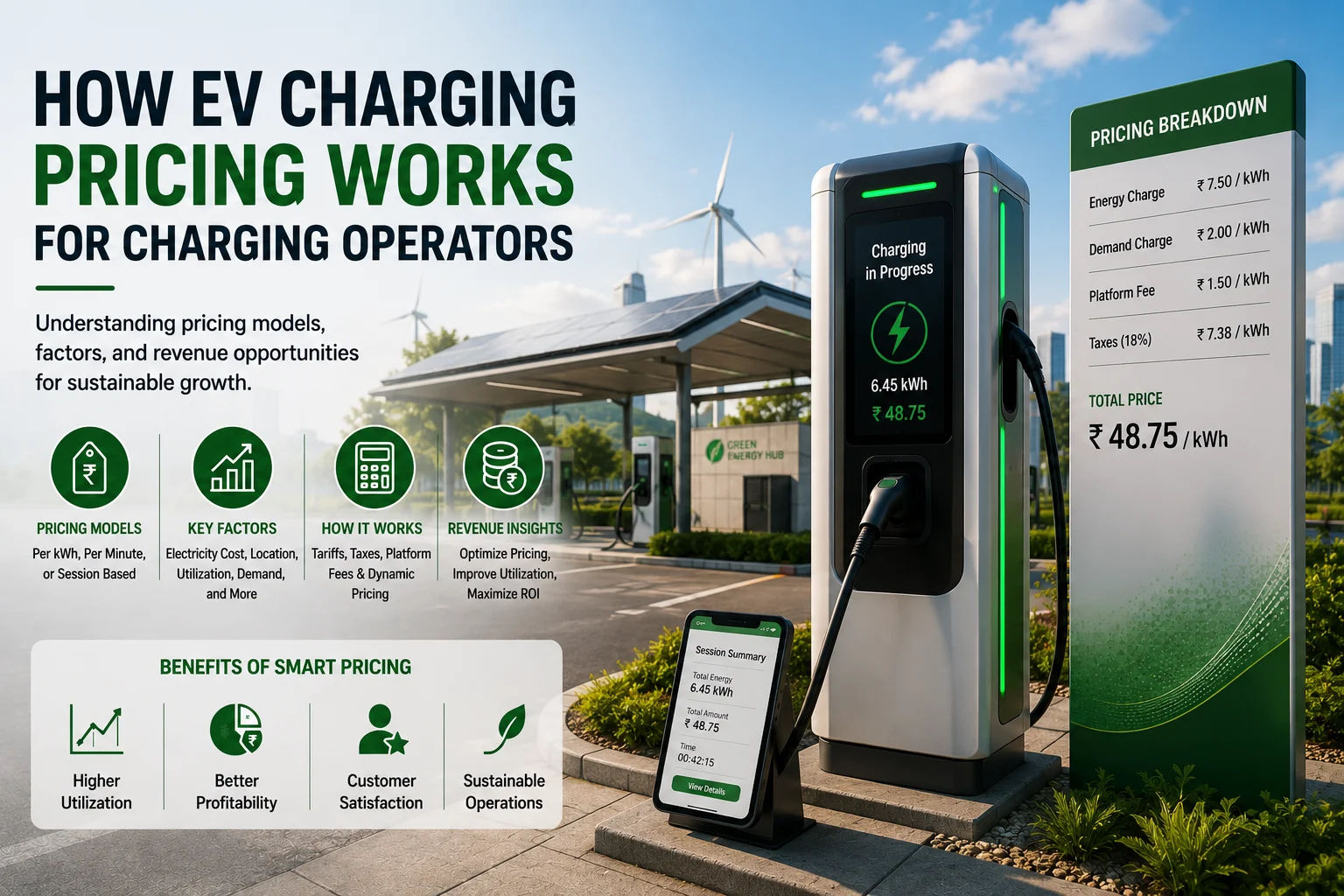
Pricing an EV Charging Service Is a Business Decision, Not Just a Per-Unit Rate
When drivers see the price of EV charging, they usually focus on what they will pay for energy. Operators, however, need to think much more broadly. The final customer price is influenced by electricity procurement, infrastructure investment, software, maintenance, payment systems, parking arrangements, utilisation and the overall operating model.
There is no universal pricing formula that works for every charging location. A housing society, shopping mall, office, fleet depot and public highway station may all operate under different economics.
The Difference Between Cost and Customer Price
Operators should separate internal operating costs from the public charging price. Electricity is one important component, but it is not the only expense involved in running a reliable charging station.
| Cost Area | Why It Matters |
|---|---|
| Electricity consumption | Variable operating cost |
| Electrical infrastructure | Initial capital investment |
| Charger hardware | Equipment investment |
| Software platform | Monitoring and session management |
| Maintenance | Reliability and uptime |
| Payment processing | Digital transaction operations |
| Site operations | Parking and facility management |
Electricity Tariffs Influence Operator Economics
Electricity tariff structures can vary depending on the applicable consumer category and state regulations. Operators should understand how energy charges, fixed charges and applicable tariff structures affect operating expenses before defining customer pricing.
Rather than assuming a single electricity rate, review the actual commercial arrangement for the charging connection and model costs accordingly.
Utilisation Changes Everything
A charging station with strong utilisation can distribute fixed operating costs across more charging sessions, while an underused charger may struggle even if the technical installation is excellent.
This is why site selection and demand assessment are closely connected to pricing strategy.
Common Pricing Models
Different operators use different commercial approaches depending on the site and customer segment.
- Energy-based pricing
- Time-based charging where applicable
- Membership or subscription benefits
- Fleet contract pricing
- Host-site partnership arrangements
- Destination charging integrated with parking
The appropriate model should reflect customer expectations, operating costs and the type of charging service being offered.
Why Location Affects Pricing Strategy
A premium highway stop may operate differently from an office or residential location because the customer value proposition is different. Highway users may prioritise speed and reliability, while office users may value convenient all-day charging.
Pricing should therefore be developed alongside the site’s operational purpose rather than copied from another charging network.
Understand the Role of Parking
Some sites integrate charging with parking policies. Operators should clearly communicate whether parking fees, charging fees or both apply so that customers understand the total cost of using the facility.
Software Helps Manage Pricing Transparently
A charging management platform can help operators configure tariffs, monitor sessions, generate reports and review revenue performance. It also supports operational transparency by recording charging activity and payment data.
Build a Pricing Model Before Launch
Before opening a charging station, prepare a financial model that estimates expected sessions, energy delivered, operating costs, maintenance, software and infrastructure recovery assumptions.
This allows the business to test different utilisation scenarios instead of relying on optimistic assumptions.
Questions Operators Should Ask
- Who are our primary users?
- How many charging sessions are expected?
- What are our electricity and operating costs?
- How will maintenance affect uptime?
- Will parking be included?
- Do fleet customers require separate contracts?
- How will pricing remain transparent for drivers?
Final Takeaway
Successful EV charging pricing is built on understanding operating economics rather than choosing an arbitrary number. Electricity cost, utilisation, maintenance, software and site operations all contribute to a sustainable pricing strategy for charging operators.
Frequently Asked Questions
Is electricity the only cost for charging operators?
No. Operators also manage infrastructure, maintenance, software, payment systems and site operations.
Why does utilisation matter?
Higher utilisation helps spread fixed operating costs across more charging sessions and can improve overall business efficiency.
Should every charging location use the same pricing?
No. Pricing should reflect the site’s users, operating model, infrastructure and customer experience.