

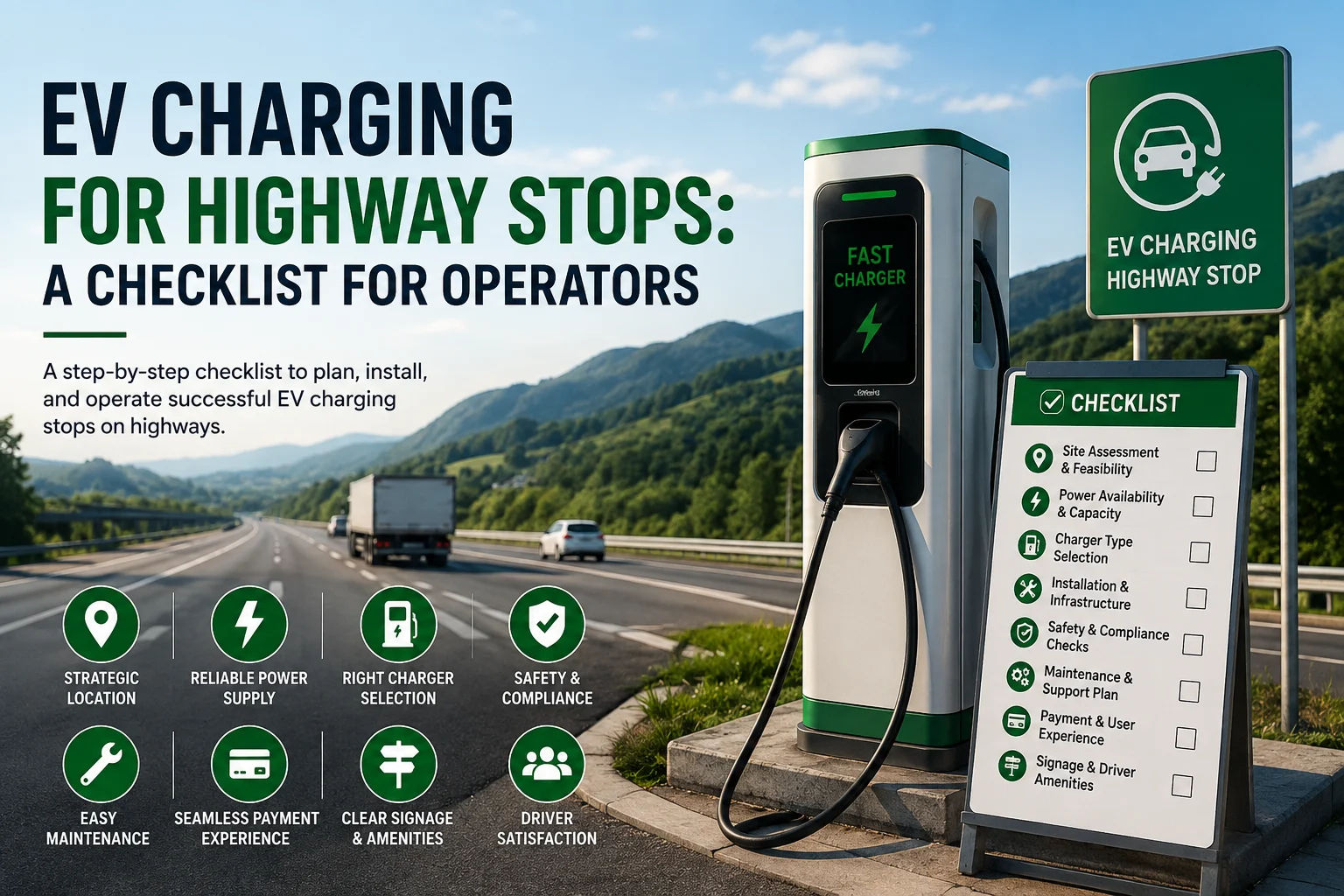
Highway EV Charging Requires More Than Installing Fast Chargers
Highway charging serves drivers who are travelling between cities and often want a predictable, reliable stop rather than simply a charging point. Operators therefore need to think about accessibility, traffic flow, amenities, uptime, safety and operational support together.
A successful highway charging stop should make the charging process easy from the moment a driver exits the road until they safely return to the highway.
1. Choose the Right Corridor
Location should be based on real travel behaviour. Study major corridors, freight movement, passenger traffic, nearby cities and existing way-side amenities before selecting a site.
A charging station placed on a convenient travel corridor is more valuable than one located several kilometres away from the driver’s natural route.
2. Prioritise Easy Entry and Exit
Drivers should be able to enter the site without difficult manoeuvring and return to the highway safely after charging. Clear approach roads, adequate turning space and organised parking circulation improve the overall experience.
3. Match Charger Capacity to Expected Users
Highway locations often serve different vehicle types including passenger EVs and, depending on the corridor, commercial vehicles. Operators should evaluate expected vehicle mix before deciding the charger configuration.
| User Type | Operational Consideration |
|---|---|
| Private cars | Reliable fast turnaround |
| Tourists | Convenient charging plus amenities |
| Commercial fleets | Scheduled operational charging |
| Long-distance travellers | High availability and predictable service |
4. Keep Reliability at the Centre
For highway drivers, arriving at an unavailable charger can significantly disrupt a journey. Operators should monitor station availability, connector status, failed charging sessions, communication connectivity and maintenance incidents continuously.
Reliability is often just as important as charging speed.
5. Provide Useful Driver Amenities
Charging naturally creates waiting time. Sites with cafés, restaurants, washrooms, convenience stores and safe waiting areas can improve the overall customer experience.
The objective is to create a practical travel stop rather than an isolated charging installation.
6. Plan Signage and Wayfinding
Drivers should be able to identify the charging station before reaching the property and navigate easily once inside. Clear directional signs, visible EV bay markings and straightforward traffic flow reduce confusion.
7. Review Electrical Infrastructure
Fast charging requires careful electrical planning. Operators should assess available load, transformer capacity, distribution systems, cable routing and future scalability before installation.
Infrastructure planning should support both today’s demand and realistic future growth.
8. Build for Operational Uptime
A highway station should have clear processes for fault detection and resolution. Monitoring software, remote diagnostics, maintenance planning and spare component availability can reduce downtime.
- Monitor charger status remotely
- Track connector-level faults
- Maintain service records
- Respond quickly to critical outages
- Review recurring failure patterns
9. Consider Safety Throughout the Site
Vehicle movement, pedestrian circulation, lighting, electrical protection, drainage and emergency access should all be included during site planning. A well-organised layout improves both safety and operational efficiency.
10. Measure What Matters
Operators should regularly review uptime, utilisation, charging sessions, energy delivered, downtime, failed session rate and maintenance performance. These metrics help identify underperforming chargers and improve future investment decisions.
Highway Operator Checklist
- Evaluate travel corridor demand
- Check easy highway access
- Plan safe entry and exit
- Select charger mix for expected vehicles
- Assess electrical infrastructure
- Provide clear signage
- Create adequate charging bays
- Offer useful traveller amenities
- Implement remote monitoring
- Establish maintenance response procedures
Final Takeaway
The best highway EV charging stops combine convenient location, dependable charging infrastructure and a reliable operational model. Drivers remember whether a charging stop was easy, safe and dependable, making uptime and accessibility central to long-term success.
Frequently Asked Questions
Why are amenities important at highway charging stops?
They improve the driver experience during charging by allowing travellers to use restaurants, washrooms or convenience facilities while their vehicle charges.
Should highway operators monitor chargers remotely?
Yes. Remote monitoring helps identify outages and faults quickly, supporting faster maintenance response.
What should operators evaluate before selecting a highway site?
Traffic patterns, accessibility, electrical capacity, parking layout, safety, amenities and future charging demand should all be reviewed together.