

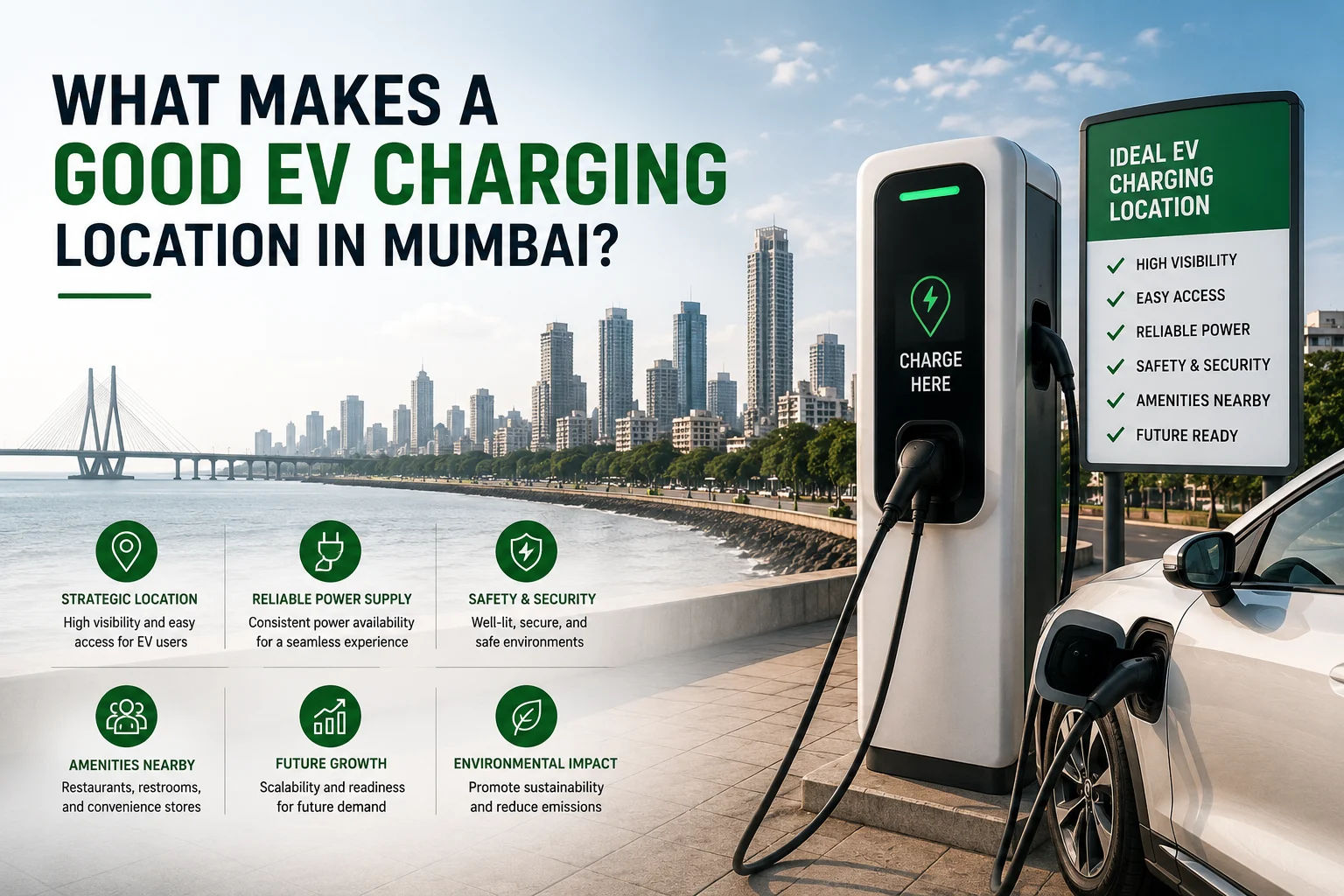
Choosing an EV charging location in Mumbai is one of the most important decisions an operator or business partner can make. A high-quality charger cannot compensate for a location that drivers cannot easily find, access or use.
Mumbai has a mix of dense residential neighbourhoods, commercial districts, shopping destinations, offices, hotels, hospitals, highways, parking facilities and fleet operations. Each type of location has a different charging requirement. The best site is therefore not necessarily the one with the highest traffic. It is the location where EV demand, parking time, accessibility, electrical capacity and business potential come together.
For first-time charging partners, evaluating these factors before installation can reduce infrastructure changes later and create a better experience for EV drivers.
Why Location Matters So Much for EV Charging
EV charging is different from conventional refuelling. Most drivers do not want to spend extra time travelling to a charger if another convenient option is available. Charging works best when it fits naturally into a driver’s existing journey.
A driver may charge while shopping, working, living in an apartment, staying at a hotel, visiting a hospital or travelling between cities. This means the value of a charging location is strongly connected to what the driver is already doing there.
A location with a reasonable amount of traffic but long parking duration can sometimes be more suitable for AC charging than a busy location where vehicles stop for only a few minutes. Similarly, a high-traffic highway location may be better suited to DC fast charging.
1. Look at EV Demand Around the Location
The first question should be: Who is likely to charge here?
Look at the surrounding catchment area and identify the types of EV users nearby. This may include private car owners, apartment residents, office employees, commercial vehicle operators, delivery fleets, taxis or highway travellers.
Consider:
- Number of residential buildings nearby
- Commercial and office activity
- Existing EV adoption in the area
- Fleet activity
- Nearby shopping and hospitality destinations
- Major roads and travel corridors
- Existing public charging stations
Demand should be evaluated as a combination of current usage and future potential rather than relying on one traffic figure.
2. Understand How Long Vehicles Stay
Dwell time is one of the most important factors when selecting a charger and location.
If vehicles typically remain parked for several hours, AC charging can make sense. Housing societies, offices, hotels and long-stay parking facilities are examples where drivers may have enough time for slower charging.
Where vehicles need to return to the road quickly, faster DC charging may be more appropriate. Highway stops, fleet depots and high-turnover commercial locations can have very different charging requirements.
The key is to match charging speed to the amount of time vehicles naturally spend at the site.
3. Prioritise Easy Access
A charger is only useful if drivers can reach it without unnecessary difficulty.
Before selecting a site, evaluate the entry and exit points, road access, turning space, parking circulation and possible congestion around the property.
Ask practical questions:
- Can a driver enter the property easily?
- Is the charging area accessible throughout the intended operating hours?
- Can vehicles reach the charger without blocking other traffic?
- Is there enough space for manoeuvring?
- Can drivers safely exit after charging?
A technically excellent site can still perform poorly if drivers find it difficult to reach the charging bays.
4. Visibility and Wayfinding Matter
Drivers should be able to identify the charging facility without confusion.
Locations with good visibility from an entrance or internal road can make the charging service easier to discover. Clear EV charging signs, bay markings and directional information can further improve the driver journey.
For larger properties such as malls, hotels, hospitals and parking facilities, wayfinding is particularly important because the charging bays may not be immediately visible from the main entrance.
5. Check Parking Availability
EV charging requires dedicated space. Operators should evaluate not only how many parking spaces are available but also whether those spaces can realistically be allocated for charging.
Consider:
- Dedicated charging bays
- Parking circulation
- Vehicle dimensions
- Connector and cable reach
- Space around the charger
- Protection from accidental vehicle impact
- Access for maintenance
The charging bay should be designed as part of the parking layout rather than added as an afterthought.
6. Evaluate Electrical Capacity Before Finalising the Site
Electrical infrastructure is one of the most important technical considerations.
The available electrical capacity needs to be evaluated against the planned charging equipment and other loads at the property. This becomes increasingly important when installing multiple chargers or higher-powered DC fast chargers.
Before committing to a location, review the existing electrical infrastructure, available load, distribution arrangement, cable routes, panel capacity and potential requirements for upgrades.
A site may have excellent customer demand but still require additional electrical planning before it can support the desired charging capacity.
7. Think About Future Charging Demand
Do not evaluate a site only according to today’s demand.
EV adoption can change over time, and a location that starts with one or two chargers may eventually need additional charging capacity. Planning space, electrical infrastructure and cable routes with future expansion in mind can reduce the difficulty of upgrading the site later.
A phased approach can be useful: start with the appropriate number of chargers for current demand while making the site ready for future expansion.
8. Match AC or DC Charging to the Location
The location should influence the charging technology, rather than choosing a charger first and trying to make the location fit.
| Location Type | Typical Charging Approach | Why |
|---|---|---|
| Housing society | AC charging | Vehicles often remain parked for long periods |
| Office | AC charging | Employees may park for several hours |
| Hotel | AC or a mix | Guests can have longer dwell times, while some locations may need faster charging |
| Mall | AC or DC / mixed | Depends on parking duration and turnover |
| Fleet depot | DC or mixed | Charging needs depend on fleet schedules |
| Highway location | DC fast charging | Drivers generally need faster turnaround |
These are planning starting points rather than fixed rules. Actual charger selection should be based on the site’s demand, vehicle mix, parking duration and electrical capacity.
9. Consider Competition From Nearby Chargers
Existing charging infrastructure around the proposed site should be part of the assessment.
Map nearby charging stations and examine their locations, charging speeds, accessibility, operating status and customer convenience. A site with little competition may have an opportunity to serve an underserved area, while a site surrounded by multiple convenient chargers may require a stronger value proposition.
Competition should not automatically disqualify a location. A strategically positioned site with better accessibility, reliability, parking or amenities can still attract drivers.
10. Look at Nearby Amenities
Charging becomes more convenient when drivers have something useful to do while their vehicle charges.
Depending on the location, useful amenities may include:
- Restaurants and cafés
- Retail stores
- Supermarkets
- Offices
- Hotels
- Rest areas
- Washrooms
- Convenience stores
This is particularly valuable for public charging because the charging experience becomes part of the driver’s overall journey rather than a separate activity.
11. Consider Operating Hours
A charging station’s value depends partly on when drivers can access it.
If a location has limited opening hours, potential charging demand outside those hours may be lost. For public charging locations, operators should consider whether access can be provided during the periods when drivers are most likely to need the service.
For offices and housing societies, access rules may be different, so charging operations should be planned around the site’s actual users and security policies.
12. Safety Should Be Part of the Site Assessment
Charging infrastructure should be installed with appropriate electrical and site safety considerations.
Review charger positioning, vehicle movement, cable management, protection from accidental impact, drainage, electrical equipment placement, emergency access and maintenance access.
Locations exposed to heavy rain should receive additional attention to drainage and equipment protection. Mumbai’s monsoon conditions make water management an important practical consideration for outdoor charging installations.
13. Check Connectivity and Software Requirements
Modern charging operations often rely on software for monitoring, session management, reporting, user access and operational visibility.
Before finalising a site, consider whether reliable connectivity is available for the planned charging equipment and management system.
Operators should also think about how they will monitor charger status, identify faults, review charging sessions and manage the station after installation.
14. Think About Maintenance Access
A charger should not be positioned in a way that makes servicing difficult.
Technicians need safe access to the equipment for inspections, troubleshooting and maintenance. The site should allow maintenance work without creating unnecessary disruption to other parking users.
Easy maintenance access can help reduce service delays and support better station uptime over the long term.
15. Evaluate the Business Potential
A good charging location should make operational and commercial sense.
Before investing, estimate potential charging demand, expected utilisation, electricity costs, operating expenses, maintenance requirements and possible revenue streams.
Also consider whether the property owner can support the required parking allocation and infrastructure work.
The strongest locations typically combine customer demand with practical infrastructure and a sustainable operating model.
16. Think About Mumbai’s Traffic Patterns
Mumbai traffic can vary significantly by time, neighbourhood and road corridor. A location that appears busy during one part of the day may have a completely different usage pattern at another time.
Evaluate traffic and parking behaviour rather than relying only on road traffic counts.
For example, an office-focused location may experience strong weekday demand, while a retail destination may see greater evening or weekend activity. A highway-oriented location can have different patterns again.
Understanding when vehicles arrive, how long they stay and when they leave is more useful than simply asking how busy the road is.
17. Use a Site Evaluation Checklist
Before approving a location, operators can score each site against a common checklist.
- EV demand potential
- Vehicle dwell time
- Parking availability
- Ease of access
- Visibility
- Wayfinding potential
- Electrical capacity
- Connectivity
- Safety
- Maintenance access
- Operating hours
- Nearby amenities
- Competition
- Future expansion potential
- Business viability
Using the same criteria for multiple locations makes it easier to compare sites objectively.
AC or DC? Start With the Location, Not the Charger
One of the most common mistakes is choosing a charger based only on its maximum power rating.
The correct question is not simply, “How fast can this charger charge?” It is:
“What type of charging experience does this location need?”
A housing society with overnight parking may not need high-powered DC charging. A highway location serving drivers who need a quick top-up may have very different requirements.
Understanding the site’s users first makes charger selection much easier.
Common Mistakes When Selecting an EV Charging Location
Choosing a location only because it has high traffic
High traffic does not automatically mean high charging demand. Parking access and dwell time are equally important.
Ignoring electrical capacity
A site may have strong demand but require significant electrical upgrades to support the planned charging equipment.
Putting chargers where parking is difficult
If drivers struggle to enter, park or exit the charging bay, the location may deliver a poor customer experience.
Forgetting future expansion
Charging demand can grow. Site planning should consider how additional chargers could be added later.
Ignoring maintenance access
Equipment that is difficult to service can create longer maintenance periods and unnecessary downtime.
Focusing only on charger speed
Faster is not always better. Charging speed should match the site’s dwell time, vehicle demand and electrical infrastructure.
A Simple Process for Finding the Right Charging Site
For first-time partners, the process can be simplified into five stages:
- Identify the users: Determine who is likely to charge at the location.
- Study dwell time: Understand how long vehicles normally remain parked.
- Check infrastructure: Evaluate parking, electrical capacity, connectivity and access.
- Assess commercial potential: Estimate demand, utilisation and operating requirements.
- Plan the charging setup: Select AC, DC or a combination based on the site’s actual needs.
This approach helps prevent the common mistake of selecting charging equipment before understanding the location.
Final Takeaway
A good EV charging location in Mumbai is not simply a place with lots of vehicles. It is a location where demand, dwell time, accessibility, parking, electrical capacity, safety and business potential work together.
For housing societies, offices, malls, hotels, fleet depots and highway locations, the ideal charging setup can be very different. The right approach is to understand the users and their behaviour first, then select the charging technology and infrastructure around those needs.
Careful site evaluation can improve utilisation, driver convenience and long-term operational performance. It can also make future expansion easier as EV adoption continues to grow.
For businesses and property owners considering EV charging in Mumbai, Weej Wala can help evaluate the charging requirements, infrastructure considerations and operational needs of a potential site.
Frequently Asked Questions
What makes a good EV charging location in Mumbai?
A good location typically combines EV demand, suitable parking, convenient access, appropriate dwell time, sufficient electrical capacity, reliable connectivity, safety and future expansion potential.
Is high traffic enough to make a good EV charging location?
No. High traffic can help, but charging demand also depends on parking availability, vehicle dwell time, accessibility, nearby amenities and the type of EV users in the area.
Should I install AC or DC chargers in Mumbai?
It depends on the location. AC charging can suit long-stay locations such as housing societies and offices, while DC charging can be more appropriate where drivers need faster turnaround. Some locations may benefit from a combination.
Why is dwell time important for EV charging?
Dwell time determines how long a vehicle is naturally available for charging. Longer parking periods can make AC charging practical, while short stops may require faster DC charging.
What electrical factors should be checked before installing EV chargers?
Operators should evaluate available electrical capacity, existing loads, distribution equipment, cable routes and whether infrastructure upgrades may be required for the planned charging setup.
Should an EV charging site be planned for future expansion?
Yes. Where possible, site planning should consider future charging demand, additional parking bays, electrical capacity and cable routes so that expansion is easier later.
Does visibility matter for a charging station?
Yes. Clear visibility, signage and wayfinding can make it easier for drivers to find charging bays and understand how to access the station.
Planning an EV charging location in Mumbai? Weej Wala can help you evaluate the site, charging requirements, infrastructure and operational considerations before you invest.