

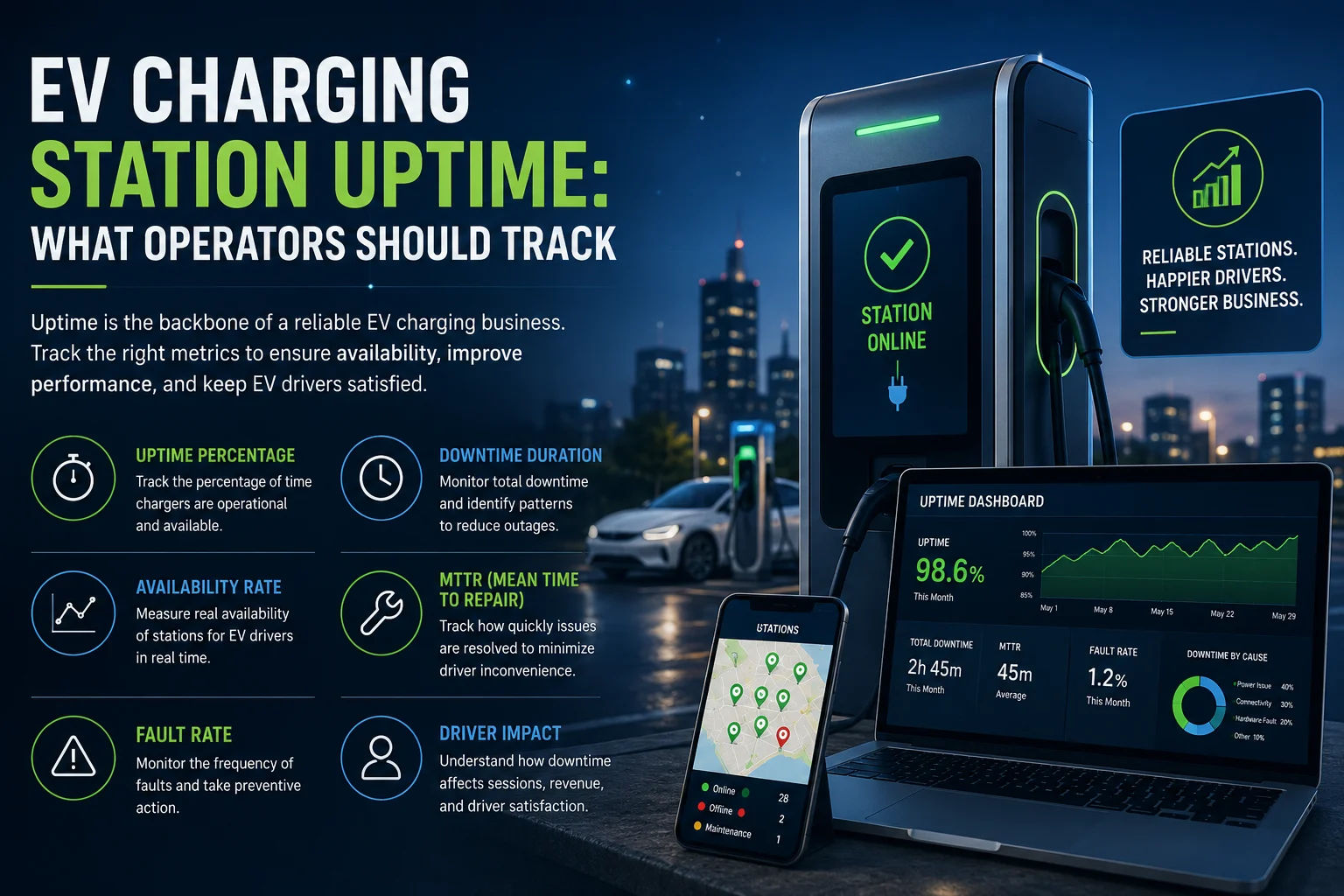
For an EV charging operator, a charger that is installed but unavailable is not really a useful charging asset. Drivers expect to arrive, start a session, charge their vehicle and complete the payment or stop process without unnecessary delays. When that experience repeatedly breaks down, the impact can go beyond one failed charging session. Poor reliability can reduce repeat usage, create support requests and affect the overall reputation of the charging location.
That is why EV charging station uptime should be treated as an operational metric rather than a number that is checked occasionally. A strong uptime strategy looks at the complete charging journey: whether a charger is online, whether it is actually available to drivers, whether sessions start successfully, whether charging continues as expected, and how quickly problems are resolved.
What Does EV Charging Station Uptime Actually Mean?
Uptime generally describes how much of the expected operating period a charging asset is available and functioning. However, operators should be careful about treating uptime as a single number.
A charger may be connected to the network and therefore appear online while still being unable to start a charging session. Similarly, a station may be technically operational but blocked by another vehicle, under maintenance, experiencing a payment problem or unable to deliver the expected power.
For this reason, operators should separate network connectivity, availability, reliability and successful charging sessions. Looking at all four gives a much clearer picture of station performance.
1. Track Charger Availability
Availability answers a simple operational question: Can a driver use the charger when they need it?
Track the percentage of time each connector is available for a new charging session. This can be more useful than looking only at the overall site-level uptime because one faulty connector can be hidden by several healthy connectors at the same location.
Review availability by charger, connector, site and time period. A weekly or monthly average can show the overall trend, while daily and hourly data can help identify recurring problems.
2. Track Actual Uptime
Uptime should be measured against the operating schedule or expected service period defined for the station. A useful calculation is:
Uptime % = (Total expected operating time − downtime) ÷ total expected operating time × 100
Do not stop at the overall percentage. Break downtime into meaningful categories such as hardware failure, communication failure, electrical interruption, scheduled maintenance, software issues and other operational causes.
3. Measure Downtime Duration
Two stations can have the same number of failures but very different business outcomes. One may recover from each issue in a few minutes, while another may remain unavailable for several hours.
Track:
- Total downtime per charger and site
- Average downtime per incident
- Longest downtime incident
- Number of downtime incidents
- Downtime by cause
- Downtime during peak demand periods
This helps operators identify whether the main problem is frequent small interruptions or fewer but much longer outages.
4. Track Failed Charging Sessions
A charger can be online and still provide a poor driver experience if sessions frequently fail to start. Session-start failures should therefore be tracked separately from downtime.
Monitor how many charging attempts are unsuccessful and identify the stage where the failure occurs. Possible causes can include authentication, payment, connector communication, vehicle compatibility, charger errors or network communication.
A rising failed-session rate is often an early warning sign that something needs investigation, even when the headline uptime percentage still looks healthy.
5. Monitor Session Success Rate
Session success rate gives operators a driver-focused view of reliability.
Session success rate = successful charging sessions ÷ total charging attempts × 100
Track this metric by individual connector and location. If one charger consistently performs below the site average, investigate it rather than assuming the entire network has a general problem.
6. Track Mean Time to Detect and Mean Time to Resolve
Finding a problem quickly is only half of the operational challenge. The team also needs to restore service quickly.
Mean Time to Detect (MTTD) measures how long it takes to identify an issue. Mean Time to Resolve (MTTR) measures how long it takes to restore normal operation after the issue is identified.
These metrics can reveal weaknesses in monitoring, escalation, field support, spare-parts availability and maintenance processes. A network with occasional faults can still perform well operationally if issues are detected and resolved quickly.
7. Track Communication and Network Connectivity
Connected chargers depend on communication between the charging hardware and the management platform. A charger that repeatedly loses connectivity may become difficult to monitor or control even if the physical hardware is working.
Track communication outages, reconnect frequency, offline duration and recurring connectivity failures. Where possible, identify whether the issue is associated with the charger, local network, SIM/connectivity service or backend system.
8. Monitor Energy Delivery and Charging Performance
Reliability is not only about whether a connector is switched on. Operators should also examine whether the charger is delivering energy as expected.
Useful operational indicators include energy delivered, charging duration, average delivered power and unusual changes in performance. A sudden drop in delivered power can indicate an electrical, thermal, hardware, vehicle or configuration issue that deserves investigation.
9. Track Connector-Level Performance
For sites with multiple connectors, site-level averages can hide individual problem assets. Connector-level reporting makes it easier to identify repeat failures.
Compare connectors using availability, successful sessions, downtime, energy delivered, fault frequency and maintenance history. A connector that repeatedly underperforms can then be prioritised for inspection or replacement.
10. Track Maintenance and Fault Trends
Every service event should contribute to an operational history. Record the date, charger, fault type, action taken, parts replaced, technician visit and restoration time.
Over time, this creates a useful maintenance dataset. Operators can identify recurring fault types, assets requiring unusually frequent intervention and components that may need preventative attention.
11. Separate Planned and Unplanned Downtime
Scheduled maintenance should not be treated the same way as an unexpected hardware failure. Both affect availability, but they require different operational responses.
Report planned maintenance separately from unplanned downtime. This makes performance reporting more transparent and helps teams understand whether availability is being reduced by controllable maintenance planning or unexpected failures.
12. Track Peak-Time Reliability
An outage during a low-demand period and an outage during a busy evening are not operationally equivalent.
Review uptime and failed sessions during the periods when the site is most heavily used. For commercial locations, these may correspond to business hours or evening demand. For highway charging, peak periods may be associated with travel patterns.
Peak-time reliability can therefore be a more meaningful operational KPI than a simple monthly average.
13. Look at Site-Level and Network-Level KPIs
Operators should use two reporting levels. Site-level reporting helps identify individual locations that need attention. Network-level reporting shows whether reliability is improving across the overall charging portfolio.
A practical dashboard can include:
- Overall network uptime
- Availability by site
- Availability by connector
- Failed session rate
- Current offline chargers
- Open maintenance incidents
- Average resolution time
- Energy delivered
- Top recurring fault categories
Why Uptime Alone Is Not Enough
A reported uptime percentage can look impressive while drivers are still experiencing problems. For example, a charger might remain online but repeatedly reject session starts, provide lower-than-expected power or become unavailable because of a payment or communication issue.
That is why operators should combine uptime with driver-facing and operational metrics. The goal is not simply to keep a charger connected to a backend platform. The goal is to provide a charging service that works when a driver needs it.
How Software Helps Operators Monitor Uptime
A charging management platform can centralise charger status, sessions, faults, energy information and operational alerts. Instead of checking individual chargers manually, operators can use a dashboard to identify offline assets and prioritise incidents.
For larger networks, automated alerts are especially useful. The operations team can receive notifications when a charger goes offline, repeatedly fails sessions or shows an unusual pattern. This allows the team to investigate before the issue becomes a larger service problem.
What a Good Uptime Dashboard Should Show
An effective dashboard should make exceptions easy to find. Operators should not have to analyse hundreds of rows of data just to discover that a charger has been offline since the previous day.
A useful dashboard can include an overall uptime figure, live station status, site-level availability, offline-duration ranking, active faults, failed-session trends and maintenance status. Filters for location, charger model, connector and date range make the information more actionable.
Creating an EV Charging Uptime Review Process
Tracking metrics is only useful when the data leads to action. A simple review process can work well:
- Check live status: identify currently offline or degraded chargers.
- Review recent incidents: look for repeated failures and long outages.
- Compare sites: identify locations performing below the network average.
- Review root causes: group failures into hardware, electrical, communication, software and operational categories.
- Prioritise: resolve issues based on customer impact, severity and frequency.
- Measure improvement: compare the same KPIs after corrective action.
Common Mistakes Operators Should Avoid
Only monitoring the overall uptime percentage
A single network-wide number can hide individual charger problems. Always drill down to the connector and site level.
Ignoring failed sessions
A charger can be online while still frustrating drivers. Session success should be a separate KPI.
Not measuring resolution time
Knowing that an incident occurred is not enough. Operators should know how quickly service was restored.
Mixing planned and unplanned downtime
Scheduled maintenance and unexpected outages have different causes and should be reported separately.
Reviewing data only at the end of the month
Monthly reporting is useful for trends, but live alerts and regular operational reviews are important for preventing extended outages.
Choosing the Right KPIs for Your Charging Network
Not every operator needs a huge list of metrics. Start with a practical core set and expand as the network grows.
For a small network, begin with availability, uptime, failed sessions, downtime duration, active faults and resolution time. As the network expands, add connector-level analysis, energy delivery trends, fault categories, peak-time performance and maintenance analytics.
Final Takeaway
EV charging station uptime is a complete operational discipline, not just a percentage on a dashboard. Operators should track whether chargers are available, whether sessions start successfully, how long outages last, how quickly faults are detected and resolved, and whether individual connectors repeatedly underperform.
For charging networks, reliability directly affects the driver experience and the value of the infrastructure. With the right monitoring, software and maintenance process, operators can identify problems earlier, reduce downtime and build a more dependable charging service.
For businesses, housing societies, fleet operators and other locations planning EV charging infrastructure, reliability should be considered from the beginning. The charger, electrical infrastructure, connectivity, software, monitoring and maintenance process all contribute to the final customer experience.
Frequently Asked Questions
What is EV charging station uptime?
EV charging station uptime is the proportion of expected operating time during which a charging asset is available and functioning. Operators should pair it with availability and session-success metrics for a fuller view of performance.
What is a good uptime metric to track?
Overall uptime is useful, but it should be combined with connector availability, failed-session rate, downtime duration and resolution time. These metrics explain what is happening behind the headline percentage.
Why can a charger be online but still unusable?
A charger can have network connectivity while experiencing a hardware, payment, authentication, connector or charging-session problem. This is why online status and successful session performance should be monitored separately.
What is MTTR in EV charging?
Mean Time to Resolve (MTTR) measures the average time required to restore service after an issue has been identified. Monitoring MTTR helps operators evaluate the effectiveness of their maintenance and support processes.
Should operators track uptime by connector?
Yes. Connector-level reporting can reveal problems that site-level averages hide, particularly at stations with multiple connectors.
How can charging software improve uptime management?
Charging management software can provide live status, fault information, session data, alerts and historical reporting. This helps operators detect issues faster and prioritise maintenance.
Want to build a reliable EV charging operation? Weej Wala can help partners evaluate charging hardware, site requirements, software management and the operational considerations needed for a dependable charging network.