

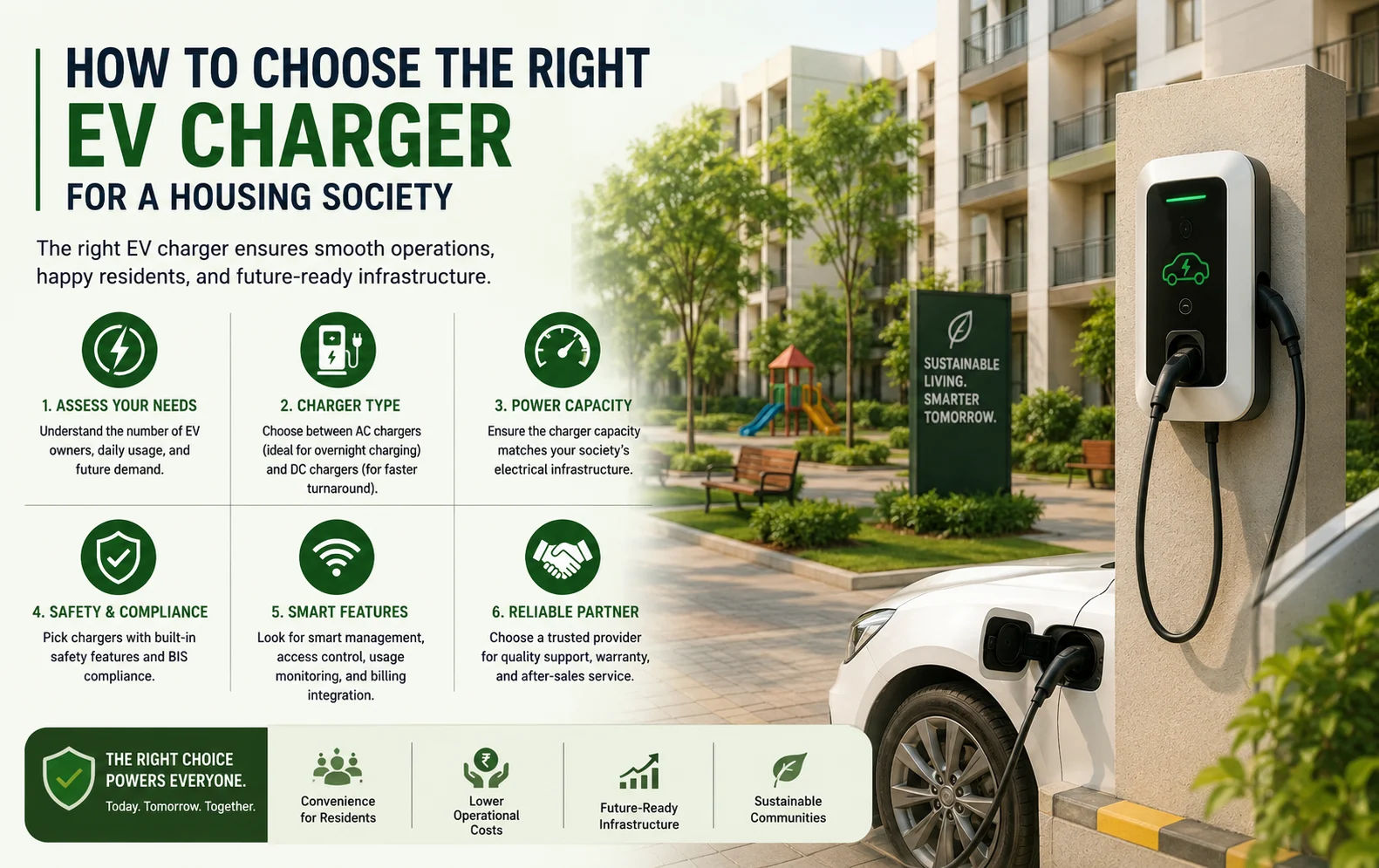
For a housing society, choosing an EV charger is not simply about buying the fastest charger available. The right solution depends on how residents use their cars, how long vehicles remain parked, how much electrical capacity the property can support, how charging will be shared and paid for, and how the society expects EV demand to grow.
In residential buildings, vehicles are often parked for several hours or overnight. That makes the charging model very different from a highway charging station where drivers may want to get back on the road quickly. A good housing-society charging plan therefore starts with the property’s actual needs rather than the charger’s headline power rating.
Start by Understanding Resident Demand
The first step is to understand the current and expected EV population within the society. The committee can survey residents to identify how many electric cars they already own, how many are considering an EV and where those vehicles are normally parked.
It is also useful to understand charging behaviour. Some residents may prefer to charge overnight, while others may need a top-up during the evening or before a long journey. This information helps determine whether the society needs a small number of shared chargers, chargers allocated to individual parking spaces, or a phased combination of both.
Do not size the entire project around today’s EV count alone. At the same time, installing a large number of high-powered chargers before there is sufficient demand can create unnecessary infrastructure and operating costs. A phased plan can provide a better balance.
AC vs DC: Which Is Better for a Housing Society?
For many residential applications, AC charging is a practical starting point because cars can remain connected for long periods. AC chargers can suit overnight charging, workplace-style residential parking and other situations where the vehicle does not need to be fully charged immediately.
DC fast charging is designed for faster charging and can make sense where rapid top-ups are genuinely required. However, DC installations generally involve greater electrical demand and more careful infrastructure planning. A society should therefore consider whether the expected use justifies the additional electrical and installation requirements.
The important question is not “Which charger is faster?” but “How quickly do our residents actually need to charge?” If most vehicles are parked overnight, charging speed may be less important than reliability, accessibility, load management and ease of payment.
When AC Charging Makes Sense
AC charging is often well matched to residential parking because the vehicle can remain parked while charging. This can make it suitable for societies where residents return home in the evening and leave again the following morning.
AC chargers can also make it easier to build a distributed residential charging network. Instead of concentrating all charging in one high-power location, a society can evaluate selected parking spaces and expand the number of charging points as adoption grows.
The exact charger rating should still be determined after reviewing the vehicle mix, electrical capacity and expected charging schedule. A higher-rated AC charger is not automatically the best choice if the building cannot comfortably support the combined load.
When DC Charging Could Be Useful
DC fast charging may be considered when residents need quicker turnaround, when vehicles are not parked for long periods, or when the society wants a dedicated rapid-charging facility for occasional use.
However, a DC charger should not be selected simply because it sounds more advanced. The society should first check available electrical capacity, installation space, cable routing, protection equipment, expected utilisation and the operating cost of the system.
For many societies, a sensible approach may be to begin with AC charging and keep the electrical and physical infrastructure ready for future expansion. Where there is a clear requirement for rapid charging, a combination of AC and DC can also be evaluated.
Check the Society’s Electrical Capacity Before Buying
One of the most important steps is an electrical assessment. EV chargers add load to a property, and several vehicles charging at the same time can create a significantly larger demand than a single charger.
The assessment should consider the available sanctioned load, transformer and distribution capacity where applicable, distribution boards, cabling, protection equipment, earthing and the proposed charger locations. Cable routes should also be planned so that charging bays can be reached safely without creating trip hazards or interfering with vehicle movement.
If the existing capacity is limited, the society should not simply select lower-powered chargers without understanding the overall electrical design. Load management and phased installation may provide a more practical path, subject to the recommendations of qualified electrical professionals.
Think About Load Management From Day One
Imagine a society with several EV owners. If every car starts charging at the same time in the evening, the combined demand can become much higher than the load created by one vehicle.
A charging management system can help operators monitor charging activity and manage available power across multiple chargers. Instead of treating every charger as an isolated device, the society can plan the charging network as one coordinated electrical system.
This becomes increasingly important as EV ownership grows. A solution that works for five EVs today may need to support twenty or fifty EVs in the future. Planning for scalability early can reduce the need for major redesign later.
Decide Whether Charging Should Be Individual or Shared
Housing societies have different parking arrangements, so there is no single model that works everywhere. Some societies may have clearly assigned parking spaces, while others may have shared or visitor parking.
For assigned parking, the society can evaluate dedicated charging points linked to particular residents. For shared parking, a common charging area may be more practical, especially when utilisation can be managed through a booking or access system.
A hybrid model can also work. A society might provide selected dedicated charging points while keeping additional shared chargers available for residents who need occasional charging.
Plan How Residents Will Pay
Electricity used for EV charging needs to be accounted for clearly. The society should decide whether charging costs will be recovered from individual users, included in maintenance charges, or handled through another approved operating model.
A transparent charging system can help avoid disputes. Residents should be able to understand how much electricity they used and what they are being charged for. Where charging software supports session tracking and payment management, it can make this process easier to administer.
The society should also define who is responsible for operating the chargers, resolving payment issues and handling maintenance requests.
Don’t Ignore Charger Connectivity and Software
The physical charger is only one part of a residential charging system. Connected charging infrastructure can provide visibility into charger status, charging sessions, energy consumption and faults.
For a society committee, this information can be useful when several residents share charging infrastructure. Remote monitoring can also help identify problems without requiring someone to inspect every charger manually.
As the number of chargers increases, software becomes more valuable because the committee needs a practical way to understand utilisation, manage access and support residents.
Consider Connector Compatibility
Before finalising a charger, the society should understand the connector requirements of the EVs that residents currently own and are likely to purchase. The objective is to make the charging facility useful to the widest practical group of residents while following the specifications of the selected equipment.
The vehicle mix may change over time, so the society should also ask suppliers about compatibility, charger standards and future expansion options rather than choosing equipment solely on price.
Parking Layout and Cable Management Matter
A charger can be technically suitable but still create problems if it is installed in the wrong location. Charging bays should be positioned so that residents can park easily, cables can be managed safely and pedestrians and other vehicles can move without obstruction.
Consider visibility, lighting, drainage, protection from accidental vehicle impact, emergency access and maintenance access. Covered and basement parking areas may require additional planning for ventilation, fire-safety considerations, water ingress and equipment placement.
Safety Should Be Part of the Design
EV charging infrastructure should be integrated into the property’s overall electrical and safety planning. Protection devices, earthing, cabling, isolation, equipment placement and installation practices should be evaluated by qualified professionals.
The society should also consider what happens during an electrical fault, how emergency access is maintained and how charging equipment will be inspected and serviced. Safety should not be treated as a final checklist after the charger has already been purchased.
What Maharashtra’s EV Policy Means for Housing Societies
Maharashtra’s EV Policy 2025 specifically addresses residential charging infrastructure. For new residential buildings, the policy states that parking spaces should be designed and constructed to be EV charging ready. It also provides for at least one dedicated community EV charging point in new residential buildings.
For existing housing societies, the policy provides for shared EV charging spaces subject to approval from at least 50% of society members and compliance with applicable safety and operational standards. fileciteturn4file0L29-L42
For a society committee, this makes early planning especially useful. Rather than waiting until charging demand becomes difficult to manage, the committee can assess parking, electrical capacity, charging demand and the operating model in advance.
A Practical Housing Society EV Charging Checklist
- Number of EVs currently owned by residents
- Expected EV adoption over the next few years
- Typical parking duration
- AC, DC or a combination of charging
- Available electrical capacity
- Distribution-board and cable requirements
- Charger locations and parking layout
- Individual versus shared charging
- Resident access and charging allocation
- Electricity billing and payment method
- Charging management and monitoring
- Maintenance and fault support
- Safety and emergency access
- Future expansion capacity
- Required society approvals and applicable standards
Should a Society Install All Chargers at Once?
Usually, the better question is whether the infrastructure should be designed for future growth rather than whether every future charger should be installed immediately.
A phased approach can allow a society to install an initial number of charging points, monitor actual usage and expand as more residents adopt EVs. At the same time, electrical routes, distribution infrastructure and parking arrangements can be planned so that expansion does not require a complete redesign.
This approach can also help the committee understand real charging behaviour before committing to a larger investment.
Common Mistakes Housing Societies Should Avoid
Choosing only by charger speed: A high-power charger is not automatically better for overnight residential parking.
Ignoring electrical capacity: The charger must be considered as part of the property’s complete electrical load.
Installing without a parking plan: Poor charger placement can create congestion, cable-management and access problems.
Forgetting future demand: A system designed only for today’s EV owners may become difficult to expand.
Leaving payments unclear: Shared charging needs a transparent method for tracking and recovering electricity costs.
Treating software as optional: As the number of chargers grows, monitoring, access control and session management become increasingly useful.
Skipping proper safety planning: Electrical protection, earthing, cable routing, emergency access and equipment placement need to be considered from the beginning.
How to Choose the Right Charger: A Simple Decision Process
Step 1: Count the current EVs. Establish how many residents need charging today.
Step 2: Estimate future demand. Consider how EV ownership could grow within the society.
Step 3: Understand dwell time. If vehicles are parked overnight, AC charging may be a strong fit. If rapid turnaround is required, evaluate whether DC charging is justified.
Step 4: Assess electrical capacity. Review the property’s available capacity and the impact of multiple simultaneous charging sessions.
Step 5: Decide the operating model. Define whether chargers will be dedicated, shared or hybrid and how residents will access them.
Step 6: Plan payments and monitoring. Make electricity recovery, session tracking and fault handling clear.
Step 7: Plan for expansion. Design the first phase so additional chargers can be added as demand increases.
Why the Right Charger Is About More Than the Charger
A successful housing-society charging project is a combination of hardware, electrical infrastructure, parking design, software, safety and operations. Selecting a charger without considering these surrounding requirements can lead to higher costs and a poor resident experience.
The best solution is therefore the one that fits the society’s actual usage pattern and can grow with EV adoption. For a residential property, reliability and convenience can be more valuable than simply having the highest charging speed.
Final Takeaway
Choosing the right EV charger for a housing society starts with understanding how residents park and charge, not with selecting the biggest charger available.
For many residential properties, AC charging can be a practical solution because vehicles remain parked for long periods. DC charging can be considered where rapid charging is genuinely required. In either case, the society should assess electrical capacity, parking layout, safety, payments, software and future expansion before installation.
Maharashtra’s EV Policy 2025 also reinforces the importance of planning residential charging infrastructure, including EV-ready parking in new residential buildings and community charging provisions. fileciteturn4file0L29-L42
If your housing society is planning EV charging, Weej Wala can help evaluate the charging requirement based on resident demand, parking, electrical capacity and future scalability, so the infrastructure is designed around how the property will actually be used.
Frequently Asked Questions
Which EV charger is best for a housing society?
There is no single charger that is best for every society. The choice depends on resident demand, parking duration, electrical capacity, charging speed requirements, operating model and future expansion.
Is AC charging suitable for apartment societies?
AC charging can be well suited to residential properties where vehicles remain parked for several hours or overnight. The exact charger rating should be selected after assessing the vehicle mix and available electrical capacity.
Should a housing society install a DC fast charger?
A DC fast charger can be considered when residents need rapid charging or when the site has a genuine requirement for faster turnaround. It generally requires more electrical capacity and careful planning than a typical AC installation.
How should residents pay for EV charging?
The society should establish a transparent system for recovering electricity costs. Session tracking and charging-management software can help record usage and make billing easier to administer.
How many EV chargers does a housing society need?
The number should be based on current EV ownership, expected adoption, parking availability, charging behaviour and electrical capacity. A phased approach can allow the society to expand as demand grows.
What does Maharashtra’s EV Policy 2025 say about housing societies?
The policy provides for community EV charging space in housing societies subject to approval from at least 50% of society members and applicable safety and operational standards. It also states that new residential buildings should have EV-ready parking and at least one dedicated community EV charging point.